The AI Blindspot: Why Financial Institutions Are Missing the Economic Revolution Right Under Their Noses
The AI Blindspot: Why Financial Institutions Are Missing the Economic Revolution Right Under Their Noses
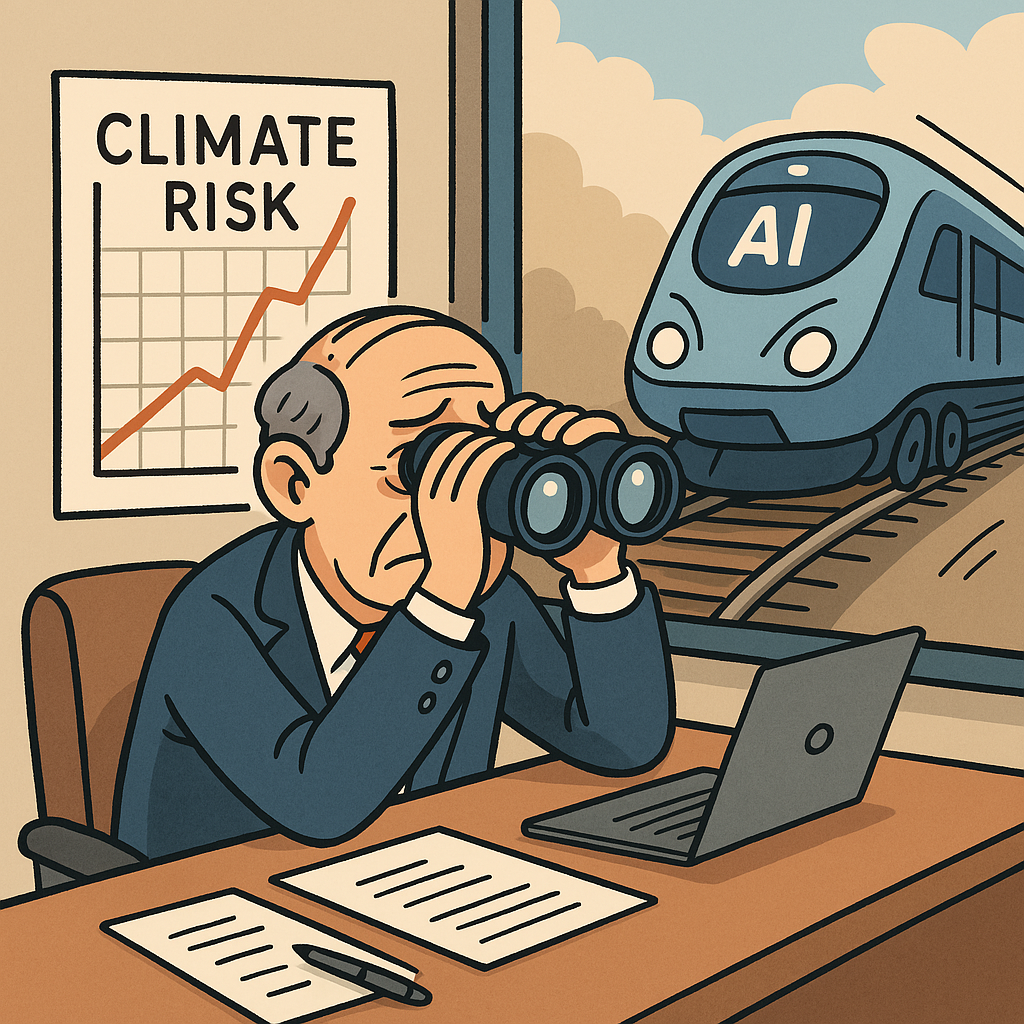
If you attend any financial conference these days, you’ll find at least three panels about climate risk. There will be earnest discussions about transition pathways, physical risks, and whether your bank should still finance drilling in the Arctic. Someone will unveil a very serious report with charts showing what might happen to coastal real estate in 2050. A sustainability officer will explain their institution’s net-zero pledges for 2045.
Meanwhile, artificial intelligence might fundamentally reshape the global economy by checks calendar 2027.
Don’t get me wrong – climate change is important. But there’s something peculiar about financial institutions meticulously stress-testing their portfolios against sea level rise in 2060 while potentially missing a more immediate economic transformation. It’s like carefully planning your retirement while ignoring the tornado heading directly for your house.
The AI Express Is Already Leaving the Station
According to the research, leading AI organizations and forecasters expect AI coding agents to reach superhuman levels by the mid-to-late 2020s. This isn’t some vague far-future prediction – we’re talking about the next 24-36 months. OpenAI’s Chief Product Officer Kevin Weil has explicitly stated that AI will surpass human coders by the end of 2025, noting “At the rate we’re going, I’d be surprised if it’s 2027. I think it’s going to be sooner.”
The AI 2027 forecasting project – involving experts from OpenAI and top forecasters – predicts that by mid-2025, coding agents will score 85% on SWE-Bench-Verified, essentially matching expert human programmer performance. We’re not talking about some marginal improvement; we’re talking about software that can write better software than humans can, creating a positive feedback loop of capability gains.
Consider the implications. Software is the backbone of all industries. An AI that can write and debug code better than humans represents a general-purpose leverage tool that can improve itself and disrupt virtually every field where software is used. Which is… everywhere.
“But Our Models Don’t Account For That”
The financial sector has gotten quite good at modeling certain kinds of risks. Credit cycles? We’ve seen those before. Interest rate shocks? There’s a model for that. Pandemic? Well, we have one now.
But rapid AI transformation presents a different challenge. It doesn’t fit neatly into existing risk frameworks. It’s not a simple “shock” but a fundamental restructuring of economic relationships. Most financial institutions are still treating AI primarily as an operational tool to improve their own processes rather than as a macroeconomic force that could reshape their entire business environment.
Think about how banks calculate credit risk. Their models typically assume that past repayment behavior predicts future behavior, with adjustments for economic conditions. But what happens when an entire occupation becomes obsolete practically overnight? Suddenly, being a “reliable borrower with 15 years in the industry” might mean a lot less if that industry is being automated away.
Tipping Points and Domino Effects
The research identifies several sectors approaching automation “tipping points”:
In transportation and logistics, autonomous vehicles and warehouse robots are steadily improving. Gartner predicts many logistics robots will mature within 2-5 years, creating an “accelerating market” and “tipping point of exponential growth.” If self-driving technology demonstrably becomes safer and cheaper than human drivers, the economics could force a rapid shift to AI drivers for fleets. This would drastically cut logistics costs (potentially by 30-50%) but also threatens approximately 3 million trucking jobs in the US alone.
Manufacturing is already seeing “lights-out” factories that operate 24/7 with minimal human intervention. In one striking example, a Chinese electronics factory replaced 90% of its 650 workers with robots, tripled its output per person, and dramatically reduced defects. This represents a 162% productivity jump - and that was back in 2015, with much less advanced AI than we have today.
These aren’t isolated cases. They’re early indicators of what happens when technologies reach critical mass. And when those dominoes start falling, they don’t fall in isolation.
Your Loan Book Is About to Get Very Interesting
The financial industry loves to slice and dice credit risk into neat categories: prime, subprime, investment grade, high yield. But AI disruption threatens to scramble these classifications faster than a quant can update a risk model.
Consider a regional bank’s commercial loan portfolio. That AAA-rated loan to a trucking company with pristine financials and 30 years of steady cash flow? It might suddenly look like a B- once autonomous trucks hit critical mass. The bank’s models didn’t flag any problems because they’re backward-looking, and the loan covenant only requires a 1.2x debt service coverage ratio. Meanwhile, the trucking company is quietly approaching a cliff, not a slope.
Or take mortgages. Banks have sophisticated models for housing price risk based on location, income demographics, and historical price movements. None of these models typically factor in “what if 30% of white-collar professionals in this zip code get their income cut in half because AI can now do their jobs?” Suddenly, that carefully constructed mortgage-backed security with geographically diversified exposure doesn’t look so diversified after all.
The most interesting part might be the inversions. Historically “safe” borrowers (middle managers at Fortune 500 companies, accountants, paralegals) might become riskier, while historically “risky” borrowers (creative professionals, skilled tradespeople whose work requires physical dexterity) might become relatively safer bets. Your risk models built on decades of lending data could become obsolete in months.
And that creates a fascinating opportunity for banks that get ahead of this shift. If you can correctly identify which sectors and borrowers will thrive in the AI economy before your competitors do, you could build a loan book that outperforms the market dramatically. The bank that figures out how to underwrite loans to “the winners” of the AI transition while avoiding “the losers” will enjoy lower default rates and higher returns than peers still using pre-AI risk models.
Of course, most banks will instead wait for defaults to start showing up in the data before adjusting their models. By which point, the arbitrage opportunity will be gone, replaced by a scramble to avoid being the last one holding the bag.
“We’re Going to Need a Different Insurance Policy”
The insurance sector faces its own reckoning. As companies rely more on AI systems, completely new failure modes emerge. Insurers are already offering “AI performance insurance” or “algorithmic liability insurance” to cover losses if an AI system malfunctions or produces harmful results.
But existing risk pools could change dramatically too. With autonomous vehicles potentially reducing accident frequency, auto insurance claims could drop sharply. This is good for society but represents a shrinking market for insurers. The flip side is product liability shifting to manufacturers – if an autonomous vehicle crashes, the claim might be against the vehicle/software maker rather than the driver.
There’s also the challenge of correlated risk. If many companies use the same AI service or model, they could all fail in similar ways. An insurer covering many of these companies has a concentrated exposure – similar to how multiple insureds might be hit by the same virus outbreak.
The Great Wealth Transfer
The wealth implications are staggering. We might see something like a “Pareto” distribution of gains – top companies and individuals gaining massively, while many others lose. AI tech firms and their investors could capture unprecedented wealth (NVIDIA’s market cap jumped by $2 trillion in 2024 due to AI enthusiasm).
Skilled AI engineers and data scientists might command seven-figure salaries, while many other professionals see wage declines as AI does part of their work. Unlike past tech waves, this time “high-skilled, high-paying jobs are vulnerable too,” as noted by FSB Chair Klaas Knot. AI can replace tasks of white-collar professionals, not just routine factory work.
This has “downstream effects” on banking: If wealth and income concentrate, the broader customer base of banks shrinks in relative terms. Banks might increasingly serve the affluent and businesses, while lower-income populations struggle. Creditworthiness divides could widen – a minority of people and firms have excellent credit (flush with AI-boosted income), while a large segment has deteriorating credit.
So What Should Financial Institutions Do?
-
Develop AI disruption scenarios: Financial institutions should create detailed scenarios for how AI might impact different sectors and incorporate these into stress testing. These scenarios should consider both gradual evolution and more abrupt transformations.
-
Update credit risk models: Lenders should assess automation risk in their lending decisions – essentially evaluating how likely a borrower’s income source is to be disrupted by AI in the next few years. This could involve creating an “AI impact index” for different occupations and industries.
-
Rethink sectoral exposures: Banks and investors should carefully evaluate their exposure to sectors likely to be disrupted. This isn’t about abandoning these sectors entirely but adjusting risk pricing and perhaps diversifying more aggressively.
-
Create new financial products: There’s an opportunity to develop products that help individuals and businesses navigate this transition. For example, “retraining loans” or income share agreements for mid-career workers learning new skills. Insurers could develop new products like income insurance that pays out if a person’s occupation gets automated.
-
Use AI to monitor AI risk: Ironically, financial institutions will likely need to use AI systems to track how other AI developments are reshaping credit landscapes and market dynamics. This creates a recursive element that requires sophisticated modeling.
-
Engage with policymakers: Financial institutions should actively participate in discussions about how to handle AI-driven economic transitions. This includes considerations about inequality, social safety nets, and potential regulatory frameworks.
The Coming Reckoning
The scale and speed of this technological shift could make climate change look like a gentle slope in comparison. Climate change unfolds over decades; AI disruption could fundamentally reshape industries in years or even months once key capabilities are unlocked.
Of course, there’s uncertainty about exactly how this plays out. The report outlines several scenarios ranging from “Moderate Automation Uptick” (gradual evolution) to “Accelerated AI Boom” (revolutionary but manageable) to “Hyper-Disruption” (a more chaotic transformation).
But even in the moderate scenario, the financial implications are significant. And if we end up closer to the accelerated or disruption scenarios? Financial institutions that weren’t prepared might find themselves facing their own existential crisis.
There’s something darkly funny about watching sophisticated financial institutions build elaborate models for climate scenarios in 2055 while potentially missing the AI revolution that could upend their business models before their current strategic plan expires. It’s like watching someone install hurricane shutters while ignoring the fire in their kitchen.
The irony, of course, is that many financial institutions are enthusiastically adopting AI tools internally for efficiency gains, without fully grappling with how the same technology might transform the economy around them. It’s as if they’re using a new power tool to renovate their house, not realizing it might also demolish the entire neighborhood.
The good news? Financial institutions that recognize this reality early have an opportunity not just to mitigate risks but to help shape a more stable transition. And they might even make some money along the way.
After all, every economic revolution creates losers and winners. It’s just a question of which side of the ledger you end up on.