When AI Makes Humans the Bottleneck: Knowledge Work's Great Inversion
When AI Makes Humans the Bottleneck: Knowledge Work’s Great Inversion
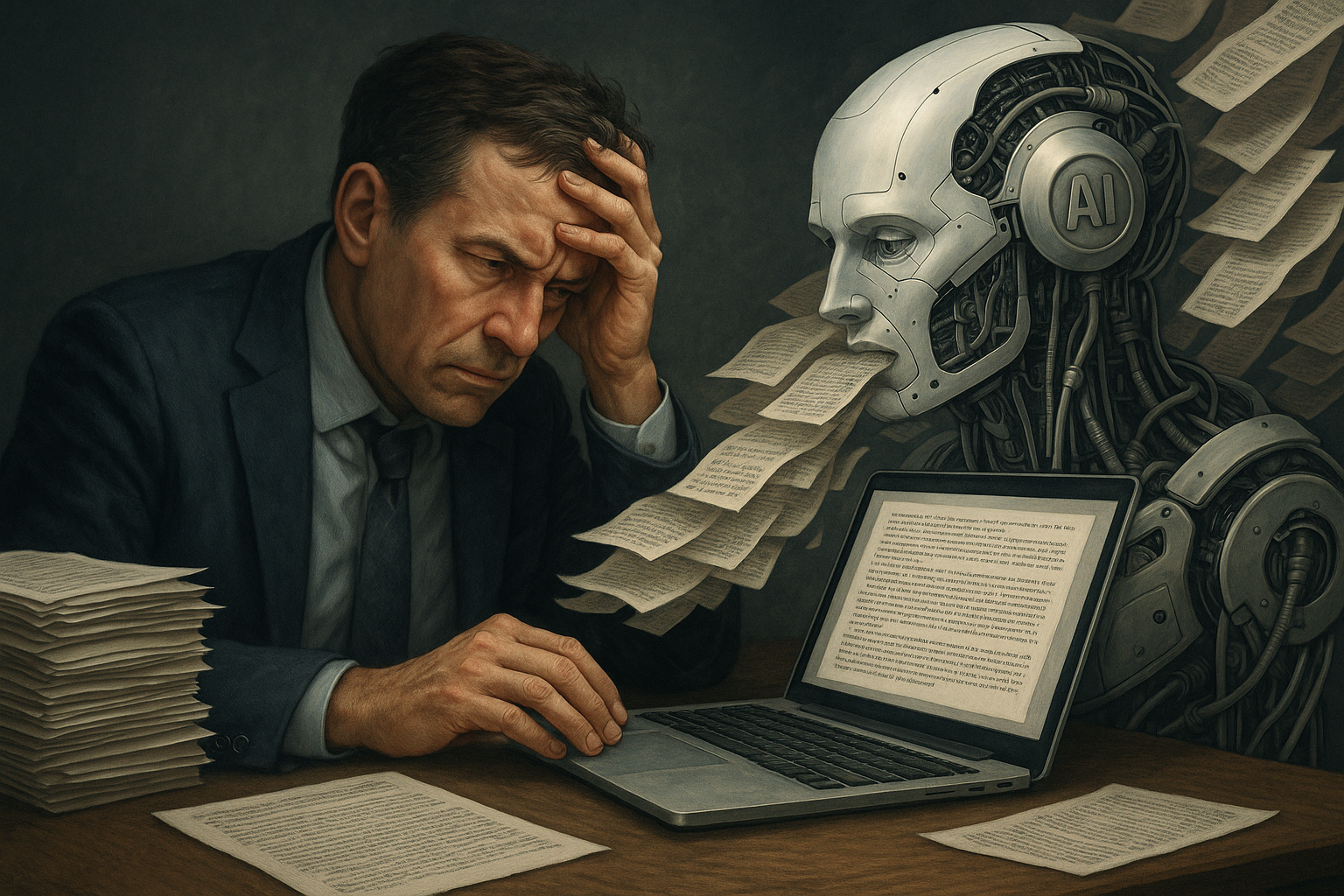
The data deluge was supposed to drown us. Instead, it’s the AI lifeguards making us realize how slowly we swim.
The Cognitive Inversion
Here’s a modern business parable: A consultant once spent a week gathering market research for a client presentation. Today, an AI does it in 20 minutes. Progress! Except now the consultant spends three days trying to absorb, verify, and make sense of all that instant analysis. The bottleneck hasn’t disappeared—it’s just moved.
Welcome to knowledge work’s great inversion. For decades, the constraint was gathering and processing information. Now, with deep-research AI agents that can inhale libraries and exhale analysis, the bottleneck has shifted to the human brain’s ability to comprehend and act on that firehose of insight.
This isn’t just interesting—it’s transformational. When AI systems can analyze a decade of financial statements faster than you can order lunch, the limiting factor becomes your cognitive bandwidth. How quickly can you absorb what the machine tells you? How thoroughly can you verify it? How confidently can you explain it to others?
The irony is exquisite: in our quest to overcome human limitations in knowledge processing, we’ve built systems that now make our biological wetware the constraint. It’s like building a highway to solve traffic jams, only to discover that cars can’t accelerate fast enough to use it properly.
The Human Hardware Limits
Our brains are remarkable but come with factory settings that can’t be upgraded via download:
-
Reading speed tops out around 300 words per minute for most humans. You can’t “overclock” your eyeball movements.
-
Working memory holds just 3-5 items simultaneously. Miller’s famous “magic number seven” was optimistic.
-
Cognitive load reaches capacity quickly when processing complex information, causing mental traffic jams.
The consultant receiving an AI-generated 50-page market analysis in minutes still needs hours to read and understand it. The lawyer who gets instant case research from an AI must still carefully evaluate its relevance and application. The bottleneck has moved from information access to information absorption.
This is Herbert Simon’s “bounded rationality” in a new context: when information is abundant, attention becomes the scarce resource. We must “satisfice” with the mental energy we have, often accepting a good-enough understanding rather than a complete one.
The Evidence Is Piling Up (Faster Than We Can Read It)
The data points supporting this shift are accumulating across industries:
GitHub’s Copilot experiment showed programmers completed tasks 55% faster with AI assistance. But that didn’t eliminate the need to understand, test, and integrate the code—it just meant the human review became the rate-limiting step.
McKinsey documented a bank’s AI system for writing credit memos that doubled relationship-manager productivity. The AI churned through data from 12+ sources in minutes, but relationship managers still needed time to interpret results and develop confidence in the conclusions.
A consulting firm found that research tasks that once took a week could be done by AI in a day—yet the total project time only dropped 30%, not 80%, because human review and contextualization remained stubbornly time-consuming.
It’s like having the world’s fastest research assistant who can compile anything instantly—but you still need to read the memo.
Three Trade-offs We’re Just Starting to Understand
This inversion introduces new challenges:
The Presence Risk: When you’re constantly consulting an AI or reading its outputs during a client meeting, you risk appearing distracted or less “present.” It’s the equivalent of checking your phone while someone’s talking—except you’re checking with an omniscient digital oracle. Clients still expect eye contact and the human touch, even as your AI whispers sweet insights in your ear.
The Bandwidth Risk: AI can feed you a constant stream of data and alerts—far more than you can consciously process. It’s like having ten assistants simultaneously shouting findings at you. Without careful progressive disclosure and prioritization, AI risks flooding your working memory.
The Client Perception Risk: Clients may wonder, “Am I paying for your expertise or the AI’s?” If your deliverable looks too AI-generated, clients question your fees. The awkward truth: efficiency without a changed business model leads to less revenue in billable-hour industries. “We did this in one-tenth the time!” is great marketing but terrible for your bottom line if you charge by the hour.
Workflow Adaptations: Training Humans to Keep Up With Their AIs
Organizations are developing strategies to maximize what humans do best—judgment, creativity, empathy—and minimize unnecessary cognitive strain:
The 1/5/20-Minute Knowledge Artifact
Instead of dumping a 100-page AI-generated report on someone, information gets organized into a 1-minute read (executive summary), a 5-minute read (extended summary), and a 20-minute read (full detail). It’s like progressive disclosure for documents—a cognitive ramp that lets you choose your depth.
Live Transcript Querying
Rather than reading every word of material, humans engage in conversation with AI to pull knowledge on the fly. “What did the third client say about supply chain issues?” gets an instant answer from the transcript. It’s just-in-time knowledge retrieval—outsourcing memory recall to the AI.
Confidence Calibration Loops
After an AI briefing, the human undergoes quick tests or flashcard-style Q&A to reinforce recall and identify gaps. This leverages the testing effect—actively retrieving information solidifies memory far better than passive review. One can imagine an operational metric like time-to-confidence: how long does it take a person, with AI help, to feel (and demonstrate) mastery of new content?
These approaches acknowledge that we can’t speed-read or expand working memory—but we can design workflows that respect cognitive limits while maximizing comprehension.
Four Futures: Where Are We Heading?
Looking ahead, several scenarios emerge:
Symbiotic Superteams: Organizations successfully integrate AI agents into knowledge workflows, creating human-AI teams that outperform either alone. The AI handles information processing, the human provides judgment and creativity. Professional identity evolves—being great at your job means being great at using AI to augment your expertise.
Organizational Brain Drain: Companies rely so heavily on externalized knowledge that internal expertise withers. When systems fail or novel situations arise, the lack of in-house wisdom becomes painfully apparent. “The AI has it” becomes an excuse not to learn deeply.
Trusted Co-Pilot Economy: Clear norms emerge for AI as a professional assistant. Organizations treat AI-curated memory as decision support rather than oracle. Regulatory frameworks legitimize AI as part of the process, with appropriate checks and transparency.
Regulatory Lockdown: Heavy regulations constrain AI use in knowledge work due to high-profile mistakes or lobbying by professional bodies. Organizations maintain AI knowledge internally but access is tightly controlled. Innovation slows as firms become cautious about AI adoption.
The future likely contains elements of all four, varying by domain and region. Finance might embrace co-pilots while healthcare faces lockdown.
The Water-Fountain Effect
Perhaps the best metaphor for our current predicament is what we might call the “water-fountain effect”: AI can fill your cup instantly, but you still have to drink at a normal pace or you’ll choke.
Researchers can request ten different AI analyses in minutes, then realize it will take hours to properly scrutinize them. A consultant can generate a dozen strategy options before lunch but still needs the afternoon to evaluate their merits. The AI firehose is attached to the human straw.
This isn’t a prediction that AI will fail or be less useful than promised. The efficiency gains are real and substantial. But they’re not evenly distributed across workflows—they accumulate primarily in data gathering and preliminary analysis, leaving human cognitive uptake as the persistent constraint.
The organizations that will thrive are those that recognize this inversion and design accordingly. They’ll measure not just how much data was analyzed, but how quickly and accurately the human team reached a confident decision. They’ll package knowledge in smarter ways, coach employees on AI collaboration, and allow time for deep integration of AI insights.
The bottleneck has shifted—our response must shift too. The future belongs not to those with the most powerful AI, but to those who best solve the human absorption problem alongside it. After all, even in an AI age, understanding remains an stubbornly human act.
In his classic “Wealth of Nations,” Adam Smith observed that “the division of labor is limited by the extent of the market.” Today we might add: “and the benefits of AI are limited by the cognitive bandwidth of its users.” Time to upgrade our wetware—or at least design better interfaces for it.