The Rise of Deep Research Agents: A Strategic Primer for Knowledge Services Executives
The Rise of Deep Research Agents: A Strategic Primer for Knowledge Services Executives
Executive Summary
Deep Research agents represent a new class of artificial intelligence systems that can autonomously navigate the web, search for information, analyze data, and produce comprehensive, cited reports on complex topics. Built on large language models (LLMs) and trained using reinforcement learning, these systems are already demonstrating capabilities that match or exceed human researchers in specific domains. OpenAI’s Deep Research and Google’s Gemini Deep Research lead the market, with other offerings from Anthropic, Perplexity, and xAI trailing significantly in the author’s testing across tasks ranging from credit ratings to real estate valuations and PE target analysis.
This primer provides executives with a comprehensive understanding of Deep Research agents—how they work, their current capabilities and limitations, and their potential to disrupt knowledge-intensive industries. Knowledge service firms that understand and adopt these technologies strategically will maintain competitive advantage; those that ignore them risk disruption. (And yes, that probably includes your firm, even if you think your analysts do Very Special Work That AI Can’t Possibly Understand™.)
Part I: The Technical Foundations
Reinforcement Learning: From Games to Research
Reinforcement learning (RL) has a long history of producing superhuman performance in narrow domains, from IBM’s Deep Blue defeating Garry Kasparov in chess to DeepMind’s AlphaGo conquering the ancient game of Go. RL systems learn optimal strategies through millions of iterations, gradually developing abilities that surpass human experts.
What makes Deep Research agents different is their domain: instead of mastering a game with fixed rules, they must navigate the unstructured, ever-changing environment of the internet and real-world information sources. (Turns out the internet is a bit more complex than chess. Who knew?)
LLMs + Reinforcement Learning: The Technical Breakthrough
Deep Research agents represent the convergence of several technical breakthroughs:
-
Large Language Models (LLMs): Foundation models like GPT-4 and Gemini 2.5 provide the base intelligence, with strong reasoning capabilities and world knowledge.
-
Tool-Using Architectures: Models trained to use external tools—searching the web, browsing pages, running code—extend beyond text generation.
-
Reinforcement Learning from Human Feedback (RLHF): Models are trained on human-preferred research trajectories and reward signals.
-
End-to-End Training in Real Environments: Rather than simulations, these systems learn by interacting with the actual web.
The development typically follows three stages:
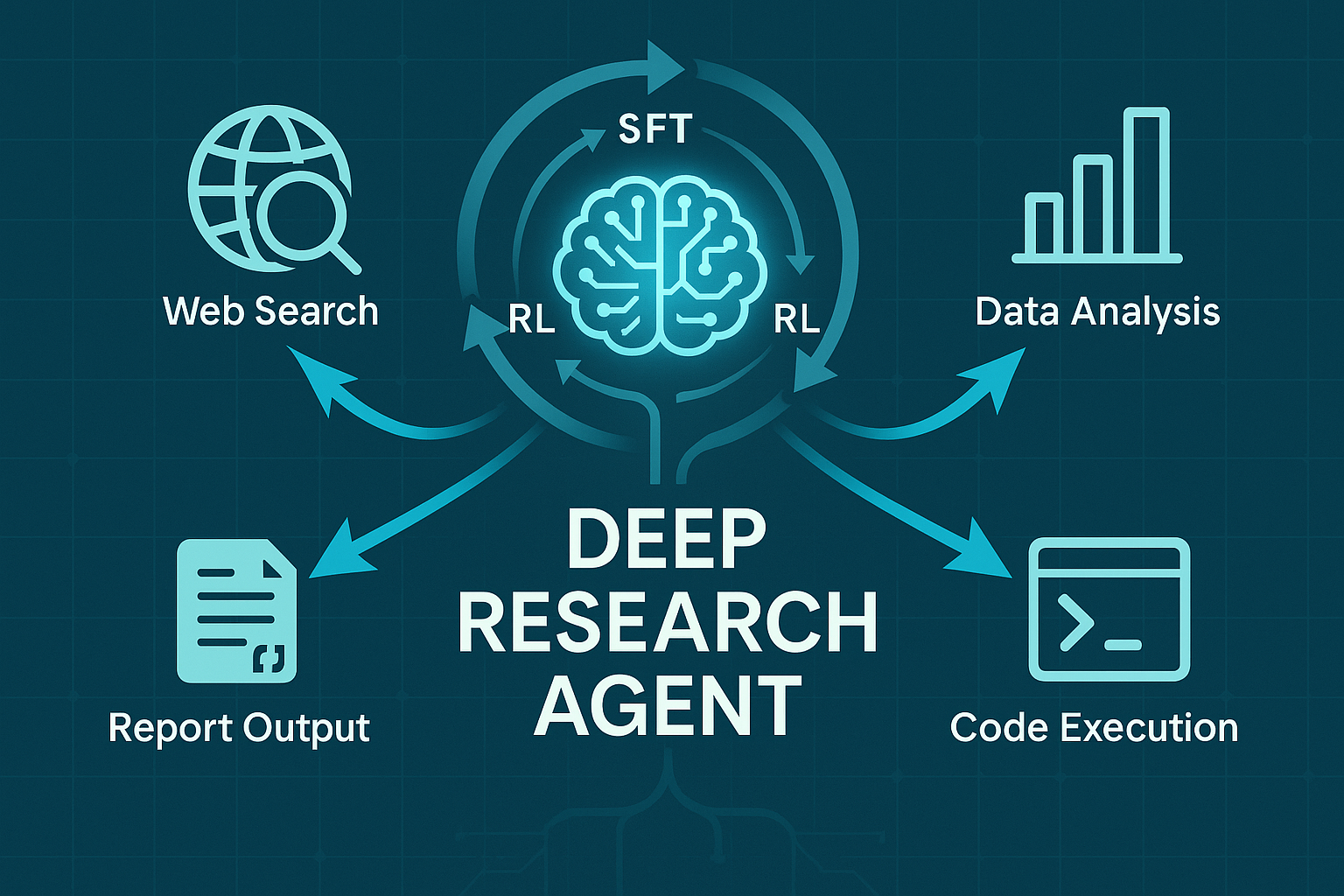
Stage 1: Supervised Fine-Tuning (SFT) Models are first trained on demonstrations of effective research—examples of search queries, web browsing, data analysis, and final answers.
Stage 2: Reinforcement Learning The model then learns through trial and error, with rewards for finding correct information, citing sources properly, and avoiding hallucinations.
Stage 3: Ongoing Improvement Models continue to improve through additional training on new examples and feedback from actual use.
How Deep Research Agents Work
Deep Research agents operate through a ReAct-style loop (Reason-Act-Observe) that combines internal reasoning with external tool use. The core architecture involves:
-
A central orchestrator (the LLM) that plans research steps and interprets results
-
External tools that extend the model’s capabilities:
- Web search (finding relevant sources)
- Web browsing (reading and extracting information from pages)
- Code execution (analyzing data, creating visualizations)
- File reading (processing user-provided documents)
When given a research query, the agent:
- Formulates initial search queries based on the question
- Evaluates search results to identify promising sources
- Browses selected pages to find relevant information
- Potentially runs code to analyze data or create visualizations
- Cross-validates information across multiple sources
- Synthesizes findings into a comprehensive answer
- Provides citations for all claims
Throughout this process, the agent maintains a “scratchpad” of found information and intermediate reasoning. Unlike simpler LLM interactions, a Deep Research session may involve dozens of individual steps over 10-30 minutes, gradually building toward a comprehensive answer. (Think of the world’s most focused research intern who never gets bored, checks Twitter, or needs a bathroom break.)
Part II: Current Capabilities and Limitations
State of the Art and Emergent Behaviors
Several major research organizations have developed Deep Research agents, with significant differences in capability:
Market Leaders
- OpenAI Deep Research: The current performance leader, built on their “o3” model, with superior capabilities in complex research tasks. Recent BrowseComp benchmark results indicate superhuman performance in internet research capabilities.
- Google’s Gemini 2.5 Pro (Deep Research Mode): Closely rivals OpenAI’s offering, leveraging Google’s search infrastructure and knowledge tools.
Secondary Players
- Anthropic, Perplexity, and xAI: Offer Deep Research capabilities but currently trail significantly in performance across tasks from credit ratings to market analysis and PE target research.
- Open-source DeepResearcher: Demonstrates that end-to-end reinforcement learning can achieve substantial improvements over simpler approaches.
One of the most interesting aspects of these systems is the emergence of sophisticated behaviors that weren’t explicitly programmed:
-
Planning behavior: The agent learns to create research plans and decompose complex queries into manageable steps.
-
Cross-validation: Even when initial results provide an answer, the agent often seeks confirmation from multiple sources to verify information.
-
Reflection and adjustment: When searches don’t yield useful results, the agent recognizes the failure and adjusts its approach.
-
Honesty about uncertainty: When unable to find definitive answers, the agent acknowledges limitations rather than making up responses.
These behaviors develop naturally through reinforcement learning, as the model learns that such strategies lead to better outcomes. (It’s a bit like if you trained a robot to make coffee and it spontaneously started wiping down the counters too—not because you told it to, but because it noticed that clean counters correlate with better coffee. Except this robot is making knowledge work instead of lattes.)
Current Limitations
Despite their impressive capabilities, Deep Research agents still face significant limitations:
- Form Factor and User Experience
- 10-30 minute wait times for results
- Comprehensive but lengthy reports that create a “water-fountain effect”
- Limited interaction during research
- One-shot nature rather than iterative research
- Brittleness with Non-Internet Sources
- Limited enterprise data integration
- Challenges with structured data
- Gated content limitations
- Credential handling issues
- Poor epistemic awareness (producing “fluff” when good data isn’t available instead of acknowledging information gaps)
- Technical and Operational Challenges
- Residual hallucination risk
- Limited source credibility assessment
- Expensive computation
- Reproducibility issues
- Safety and alignment concerns
These limitations mean that while Deep Research agents can dramatically accelerate information gathering, they may create a new bottleneck at the human consumption stage. (It’s a bit like asking for directions and getting a 100-page atlas in response. Yes, the information is in there somewhere, but was this really faster than just asking a local?)
Part III: The Next Breakthrough in LLM Value Creation
Parallels with AI-Powered Coding Tools
The trajectory of Deep Research agents resembles that of AI-powered coding tools, which offer insights into how this technology might evolve:
-
From assistance to augmentation: Early code-completion tools like GitHub Copilot began as helpful but limited assistants. They’ve evolved into sophisticated pair-programmers.
-
Productivity amplification: Tools like Cursor and Windsurf have demonstrated dramatic productivity improvements for software developers, with studies showing 30-50% faster code production.
-
Integration with workflows: Rather than replacing developers, these tools have been integrated into existing development environments.
-
Ecosystem development: A rich ecosystem of plugins, extensions, and specialized versions has emerged.
Deep Research agents appear positioned for a similar evolution—from current prototypes to workflow-integrated tools that dramatically amplify knowledge workers’ capabilities. (Though one hopes they evolve faster than your company’s ERP implementation.)
Value Creation Potential
The potential value creation from Deep Research agents comes from several sources:
- Time compression: Tasks that previously took days or weeks can potentially be completed in hours.
- Coverage expansion: Exploration of far more sources than a human researcher.
- Pattern recognition: Identification of connections that might not be apparent to human researchers.
- Democratization of expertise: High-quality research accessible to organizations without large specialized research teams.
- Cost efficiency: Potentially more cost-effective than human researchers for many tasks.
The GitHub Copilot economic impact model suggests a potential template: Microsoft claimed $1.5-$1.9 billion in increased developer productivity in its first year of deployment. Market valuations further validate this impact, with Cursor reportedly reaching a $10 billion valuation and OpenAI reportedly attempting to acquire Windsurf for approximately $3 billion. Similarly, Deep Research agents could drive significant value once integrated into knowledge work workflows.
Part IV: Required Evolution in Models and Workflows
For Deep Research agents to realize their potential, several advances are necessary:
State Maintenance and Knowledge Base Curation
Future systems will need:
- Persistent knowledge bases across sessions
- Fact tracking and provenance
- Contradiction detection and resolution
- Queryable research memory
Multi-Scale Research Capabilities
Systems must support research at multiple scales:
- Deep research for complex questions
- Medium research for focused investigations (5-10 minutes)
- Small research for quick fact-checking (seconds or minutes)
- Follow-up capabilities for iterative research
This multi-scale approach should be supported by a corresponding model scaling strategy, with smaller, cheaper, and lower-latency models specifically trained for all but the deepest research tasks. This ensures cost-effectiveness and appropriate response times for different query types.
Seamless Data Integration
Critical evolutions include:
- Enterprise data connectors
- Subscription service access
- Real-time data sources
- Multi-modal data processing
- Legacy system integration
Human-in-the-Loop Collaboration
Closer integration between humans and AI:
- Interactive research sessions
- Progressive disclosure of information
- Research co-pilots
- Learning from human feedback
- Insight surfacing
These capabilities would address the “cognitive inversion”:
“Welcome to knowledge work’s great inversion. For decades, the constraint was gathering and processing information. Now, with deep-research AI agents that can inhale libraries and exhale analysis, the bottleneck has shifted to the human brain’s ability to comprehend and act on that firehose of insight.”
Team Collaboration and Workflow Integration
Enterprise adoption will require:
- Shared research repositories
- Research version control
- Review and verification workflows
- Integration with existing tools
- Cross-agent collaboration
Part V: Strategic Implications for Knowledge Services Firms
Disruption Potential and Industry Applications
Deep Research agents have significant potential to transform knowledge-intensive industries through specialized vertical applications:
-
Financial Analysis: Systems trained on financial filings and market data could transform equity research, automate company valuation processes, and enable more sophisticated market trend analysis with far less human effort.
-
Legal Services: Agents optimized for case law, regulations, and contracts could reshape legal research, enabling comprehensive precedent identification and regulatory analysis that previously required teams of junior associates.
-
Management Consulting: Research tools specialized in industry analysis, competitive intelligence, and best practice identification could compress project timelines and fundamentally change traditional staffing models and knowledge hierarchies.
-
Life Sciences: Specialized agents for biomedical literature, clinical trials, and regulatory documents could dramatically accelerate research and development, reducing the time needed for literature reviews from weeks to hours.
-
Real Estate: Agents analyzing property listings, transaction histories, and market trends could enable rapid portfolio assessment and drive-by valuations with minimal human input.
As these capabilities mature, they will likely follow a pattern similar to other technological disruptions—beginning as productivity tools before gradually transforming business models and organizational structures. These specialized applications will combine general research capabilities with domain-specific knowledge, terminology, and data sources, creating increasingly powerful tools tailored to specific professional contexts. (And yes, that probably means fewer entry-level research positions and more “research prompt engineering” roles. Time to update the career pages.)
Organizational and Talent Implications
The emergence of Deep Research agents will likely transform organizational structures and talent requirements:
- New roles: “Research Engineer” or “AI Research Strategist” positions may emerge.
- Changing skill profiles: Knowledge workers will need skills in prompt engineering, research direction, and result verification.
- Organizational structure: Traditional research teams may evolve from hierarchical structures to flatter models.
- Human specialization: Human experts will focus on judgment, creativity, and interpersonal communication.
- Training and development: Organizations will need programs to help knowledge workers adapt.
These changes echo patterns seen in other industries transformed by automation, where technology handles routine tasks while humans focus on higher-value activities. (Though someone might want to check in on how all those first-year associates and analysts are feeling about their career prospects right about now.)
Conclusion: Preparing for the Future of Knowledge Work
Deep Research agents represent a significant evolution in artificial intelligence—moving beyond language generation to autonomous information gathering, analysis, and synthesis. While still early in their development, these systems already demonstrate capabilities that exceed human researchers in specific domains.
For knowledge services executives, the strategic implications are clear:
- Disruption is coming: The combination of LLMs and reinforcement learning will transform how research is conducted across industries.
- Early experimentation is valuable: Organizations that begin working with these technologies now will be better positioned as they mature.
- Human-AI collaboration is key: The most effective implementations will combine AI research capabilities with human expertise and judgment.
- Business models will evolve: The economics and delivery models of knowledge services will likely transform.
- Competitive advantage will shift: Sustainable advantage will come from asking the right questions and applying insights effectively.
Organizations that recognize this milestone and begin preparing for its implications will be best positioned to thrive in the transformed landscape of knowledge work. (And those that don’t? Well, there’s always a future in artisanal, hand-crafted research reports for the nostalgic connoisseur.)