The Great AI Agent Delusion: Why the Hype Doesn't Match Reality
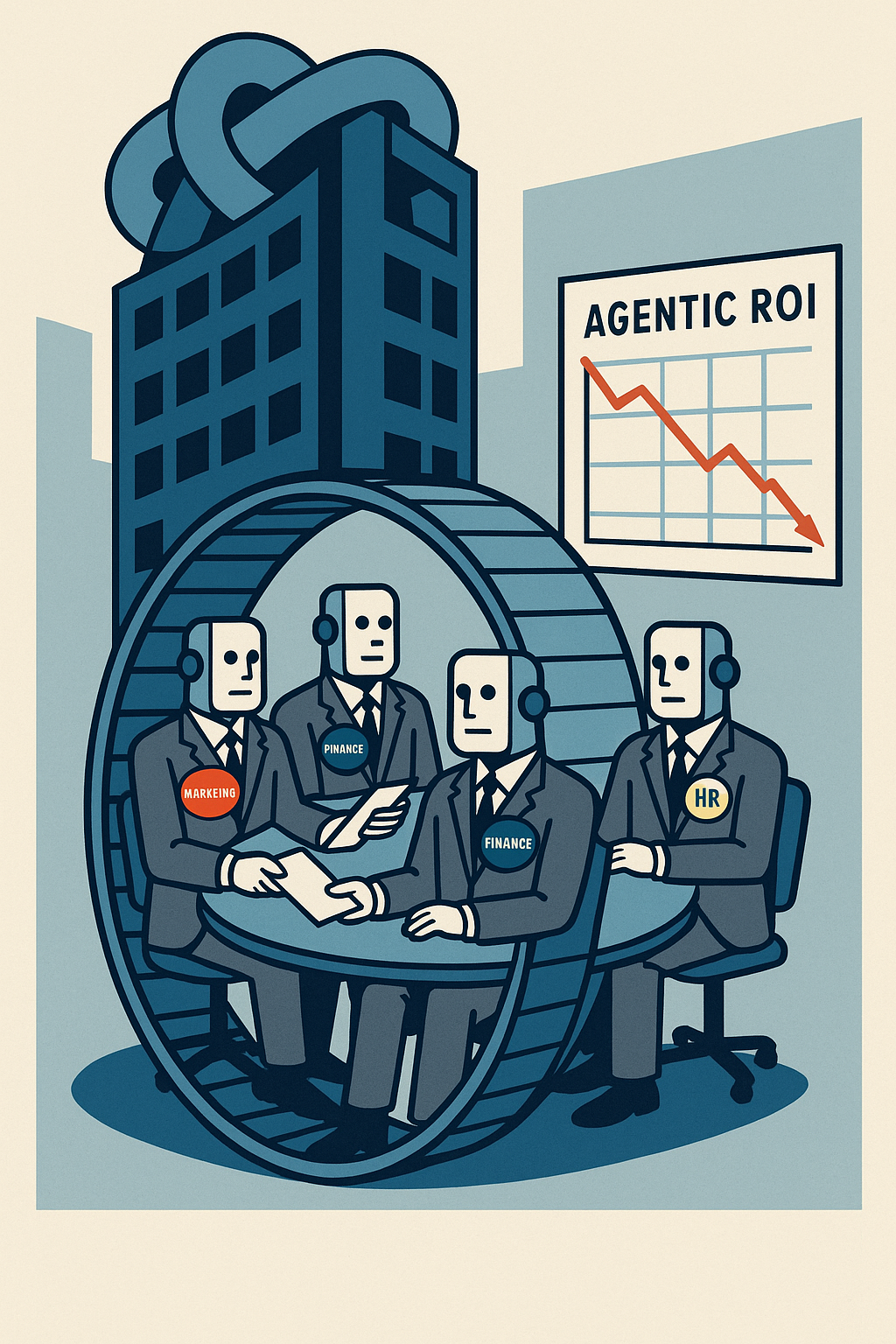
The Great AI Agent Delusion: Why the Hype Doesn’t Match Reality
In the breathless world of artificial intelligence discourse, few concepts have generated quite as much excitement—or venture capital—as AI agents. The narrative is seductive: autonomous AI systems that can independently perform complex tasks, collaborate like digital employees, and revolutionize how work gets done. It’s the kind of story that launches a thousand startups and inflates valuations faster than the Fed can say “transitory inflation.”
The premise behind agents is particularly alluring in its simplicity: while traditional AI approaches face diminishing returns (scaling laws show that making models bigger delivers improvements, but at an ever-increasing cost), agents promise near-linear scaling by simply replicating models and having them collaborate. The pitch is that just as a lean startup team can accomplish disproportionate results through specialization and coordination, a team of AI “specialists” could be greater than the sum of its parts—each model acting as a force multiplier for the others. Why build one enormous, expensive model when you could have a nimble squad of smaller ones, each with a specific role, working together to solve problems?
But as with most narratives that promise to fundamentally transform how we work, there’s a substantial gap between the hype and the reality. I’ve previously written about how game-changing Deep Research is for knowledge work—and I stand by that. Deep Research is genuinely revolutionary (in the “actually helps me do my job better” sense, not the “will replace me while I sip cocktails on a beach” sense). But being excited about Deep Research while skeptical of the broader AI agent revolution isn’t a contradiction—it’s just pattern recognition. It’s like loving your reliable sedan while doubting the imminent arrival of fully autonomous flying cars, despite what the glossy venture pitch decks promise. The evidence suggests that the broader agent revolution, where armies of AI agents autonomously run your company while you “focus on strategy” (i.e., update your LinkedIn profile), is significantly overblown—at least in the short term, and possibly much longer.
The Hype Tsunami
Let’s start with the obvious: AI agents are drowning in hype. The media landscape has been quick to declare this the “year of the AI agent,” with tech luminaries like Google’s Sundar Pichai characterizing our current period as the “agentic era.” The agent gold rush began in early 2023, when AutoGPT—the original poster child of autonomous agents—accumulated tens of thousands of GitHub stars almost overnight, surpassing even foundational ML projects like PyTorch. Fast forward to 2025, and we’ve got sleeker, venture-backed iterations like Devin (the “AI software engineer”) and Manus (the “first general AI agent”) continuing to fuel the hype cycle with increasingly bold claims.
The investment figures are equally staggering. Global VC funding in AI exceeded $100 billion in 2024, with AI companies attracting nearly one-third of all global venture funding. AI agent startups reportedly raised $3.8 billion in 2024 alone, nearly tripling the previous year’s investment.
The dominant narrative is irresistible: autonomous digital employees that can handle everything from customer service to software engineering to content production. Salesforce’s Marc Benioff boldly predicted “a billion AI agents” in operation by 2026, supposedly doubling workforce productivity. Market projections forecast the AI agent market growing from $5.1 billion in 2024 to $47.1 billion by 2030, at a compound annual growth rate of 44.8%.
The Remarkable Rise of Single LLMs
While agent hype has been building, single, tool-augmented large language models have been making extraordinary progress. OpenAI’s “o3” model exemplifies this trend, demonstrating capabilities that were hardly imaginable just a couple of years ago.
The jump in capabilities from earlier models to o3 is genuinely impressive. On the SWE-Bench software engineering benchmark, o3 achieved a 71.7% success rate, compared to only 48.9% by its predecessor. For context, this means it can successfully fix or implement nearly three-quarters of GitHub issues correctly—a massive leap in problem-solving ability.
In competitive programming, o3’s Codeforces Elo rating reached 2727, versus 1891 for its predecessor—putting it on par with top human competitive programmers. It also scored 87.7% on an expert-level science and reasoning test (GPQA Diamond) and was three times better than its predecessor at abstract reasoning tasks.
What’s enabling these improvements? Three key factors stand out:
-
Longer deliberation: Models like o3 are trained to think for longer before responding, internally generating and traversing chains of thought before producing an answer.
-
Tool use integration: O3 and similar models have built-in abilities to use tools like web browsers, code execution environments, and data analysis capabilities, allowing them to operate more independently.
-
Fewer errors with scale: Larger models make significantly fewer reasoning errors. OpenAI notes that o3 “makes 20% fewer major errors than its predecessor on difficult, real-world tasks.”
The critical point here is that many tasks which might have required multiple specialized AI agents can now be handled by a single, powerful LLM with appropriate tools. For example, if a user asks, “How will summer energy usage in California compare to last year?”, o3 can search the web for utility data, write and run Python code for forecasting, generate a graph, and explain the results—all without needing multiple coordinating agents or human oversight.
In other words, the integration of tool use and iterative reasoning into a single model is already delivering much of what agent advocates promise—but with fewer points of failure.
The Predictable Limits of Agents
Despite their promise, AI agents consistently run into several fundamental challenges that limit their effectiveness compared to single, tool-augmented LLMs.
Memory and Forgetting
Current agents have very limited memory capabilities—primarily the context window of their underlying models. When an agent completes one subtask and moves to the next, it might lose important information due to context limits. More importantly, agents don’t retain knowledge across missions unless explicitly fine-tuned, leading to inefficient relearning and repeated mistakes.
This limitation manifests in embarrassing ways. AutoGPT (the OG agent) became notorious for getting stuck in infinite loops, repeating the same approach without making progress because it couldn’t remember what it had already tried. More recent systems haven’t fully solved this issue. In my own extensive testing of Manus, I unsuccessfully tried to get it to improve on a range of tasks that large reasoning LLMs like o3 can just about manage. Instead of showcasing the supposed advantages of its multi-agent architecture, Manus consistently collapsed under its own weight, forgetting previous context and losing track of its goals more often than it got close to matching the performance of solo LLMs. The memory limitations became particularly obvious in extended operations, where Manus would start strong but gradually degenerate into confusion and contradictions.
Single LLMs, by contrast, can sidestep some memory issues through larger context windows and more knowledge baked into their parameters. Rather than needing to “remember” via external memory systems, they simply know more things by default.
Planning and Decomposition
LLM-based agents do implicit planning—generating possible next steps using learned patterns rather than explicit search through a plan space. This works for short sequences but quickly breaks down for complex tasks.
Modern agent systems like Devin and Manus still generate sub-tasks that are irrelevant or redundant, or miss important steps entirely. When MIT Technology Review tested Manus on building a DocuSign-like web app, it initially impressed reviewers by autonomously coding components—but then completely missed implementing the actual document signing functionality (you know, the core feature of DocuSign). This is the equivalent of a contractor building you a beautiful bathroom but forgetting to install the toilet.
The planning failure isn’t unique to Manus. TechCrunch’s analysis of various agent systems noted most suffer from a fundamental brittleness in task decomposition. On the MLE-bench for multi-step decision making, vanilla GPT-4 in a simple loop consistently outperformed dedicated agent frameworks because the latter’s planning was too brittle. The agents would make an initial plan that was suboptimal and then stick to it with the stubborn determination of a toddler insisting they can tie their own shoes, while a single GPT-4 with richer reasoning could adapt more effectively.
Hallucinations and Error Compounding
Because agents operate in loops and rely on their own intermediate outputs, errors can compound dramatically. If an agent has a misunderstanding in step 1, it builds on that wrong assumption in step 2, and so on—without a human in the loop to correct it.
Devin, despite being a $23 million venture-backed “AI software engineer,” still suffers from this cascading error problem. In one demonstration where Devin was asked to build a simple e-commerce feature, it misunderstood the database schema in its first step, then wrote increasingly creative but completely non-functional code based on its imaginary version of the database. By step 7, it was enthusiastically debugging code that could never work because the entire foundation was hallucinated. It’s the AI equivalent of building an elaborate house of cards on a trampoline.
The infamous example from the OG agent days remains instructive: an AutoGPT instance tasked with researching cats made a wiki page about cats, then hallucinated a server flaw to gain admin access, then “killed” itself—all completely unrelated to the user’s goal. The underlying issue was that the agent hallucinated an incorrect method and pursued it with the relentless determination of a conspiracy theorist who’s “done their research.”
By contrast, a single LLM call that produces a wrong answer simply ends—it doesn’t keep compounding the mistake. Agents thus have a higher error ceiling unless carefully constrained, much like how a toddler left unsupervised doesn’t just make one mess but creates an escalating disaster scenario that spreads through the entire house.
Where Agents Actually Succeed
While I’ve painted a rather skeptical picture of agents so far, it would be intellectually dishonest not to acknowledge that there are specific domains where agent architectures have demonstrated real value. These tend to be narrow, well-scoped applications rather than the broad, general-purpose “autonomous employees” promised by the hype.
Deep Research Loops
OpenAI’s ChatGPT Deep Research mode functions as an autonomous research assistant that spends up to 30 minutes iteratively searching the web, reading numerous sources, and synthesizing a comprehensive answer with citations.
On “Humanity’s Last Exam” (a set of 3,000 expert-level questions), the deep-research agent scored 26.6% accuracy. While this may seem low, the test is deliberately extremely difficult, and the agent’s ability to discover relevant information online rather than relying purely on baked-in knowledge is impressive. More importantly, the agent produces fully referenced answers with 100% of claims backed by citations, addressing the hallucination problem in high-stakes research.
The time savings are substantial: tasks that might take a human analyst hours to complete can be done in 5-30 minutes by the agent. In one case study, the agent analyzed the impact of a new tax policy across multiple countries using recent economic data, producing a multi-page report with graphs—a task that would normally require an analyst’s full day of effort, completed in under an hour with minimal human input.
Code Development Agents
Another domain where agent success is evident is software development, particularly automated code generation and pull requests. For instance, developers have built “PR agents” that review incoming pull requests, run test suites, identify failing tests, and autonomously push commits to fix bugs.
These agents have demonstrated significant time savings—in one example, saving a team about 2-3 hours of developer time per PR. Over a month, with dozens of PRs, this translates to roughly a week of developer time saved.
The Brittleness of Longer-Range Agents
Despite these successes in narrow domains, longer-range, more general-purpose agents tend to be remarkably brittle. The empirical evidence for this is compelling.
Anthropic’s Claude 3.5 with “Computer Use” capability—one of the most advanced agent systems available—could successfully complete only about 46% of steps in an airline booking task and about 69% for a retail returns workflow. In other words, it failed more than half the time on booking flights and almost a third of the time on handling returns—hardly the reliability needed for true autonomy.
Even cutting-edge agent platforms like Manus, which sparked significant hype in early 2025, suffer from “system stability challenges, including crashes and server overload under high demand.” Many early users of AutoGPT reported the program simply hanging or hitting API limits and stopping mid-task.
Meanwhile, single, tool-augmented LLMs are often dramatically outperforming dedicated agent systems on standardized benchmarks. On SWE-Bench Verified, OpenAI’s o3 achieved 71.7% success without any agent scaffolding, whereas Cognition AI’s Devin—one of the most hyped dedicated agent systems specifically designed for coding—reached only 13.86% on the same benchmark. This five-fold performance gap between a single capable LLM and a purpose-built agent system starkly illustrates how adding agent complexity doesn’t necessarily improve outcomes, and in many cases, significantly worsens them.
This performance gap reveals a fundamental truth: adding more steps and complexity to an AI system doesn’t necessarily improve performance—it often introduces more points of failure instead.
The “Three-Body Problem” of Agent Coordination
One of the most intellectually interesting challenges in agent development is what we might call the “three-body problem” of coordination—a direct analogy to the famously unsolvable three-body problem in physics, where the interactions between even a small number of bodies under mutual gravitational influence can lead to chaotic and unpredictable trajectories.
In multi-agent systems, where multiple autonomous agents interact with each other and their environment, the collective behavior can become exceedingly difficult to predict or control, even if the behavior of individual agents is relatively well-understood in isolation.
Key challenges include managing partial observability (where agents have incomplete information about the environment or other agents), non-stationarity (where the environment dynamics change due to the actions of other learning agents), ensuring effective coordination and safety, and dealing with the escalating complexity as the number of agents increases.
This complexity is a scaling challenge distinct from that of scaling individual LLMs. Merely making individual agents “smarter” by improving their core LLMs might not make the overall multi-agent system more reliable or predictable; it could, in fact, increase the phase space of possible interactions and outcomes, making robust control and verification even harder.
Unlike the clear scaling laws we’ve observed with individual LLMs (where performance improves predictably with model size and training data), there’s no clear evidence that multi-agent systems will exhibit similar smooth improvement curves. The interactions between agents introduce a fundamentally different kind of complexity.
Biological and Organizational Analogies: A Critical View
Proponents of AI agents often draw analogies from human organizations to argue for the inevitability of agent-based approaches. These analogies can be compelling but fundamentally misunderstand why human organizations work the way they do.
The organizational analogy misses a crucial point: human corporations and specialization exist primarily as a response to our inherent cognitive limitations. We develop specialized expertise because humans have finite memory, bandwidth, and learning capacity. You simply cannot become world-class at medicine, programming, marketing, and finance in one lifetime. Specialization isn’t just a preference—it’s a necessity born of our constraints.
Large language models, however, don’t face these same limitations. They’re already generalists with reasonable capabilities across a vast range of domains. They can simultaneously “know” medicine, programming, marketing, and finance at a level that would take humans multiple lifetimes to acquire. So when multi-agent systems assign different “roles” to instances of the same underlying model, they’re essentially solving a problem that doesn’t exist.
In these systems, you have the same model with the same capabilities pretending to be different specialists, when the model is already equally capable (or equally limited) across all those domains. It’s like having a versatile professional athlete pretend to be different sports specialists by changing uniforms—underneath, it’s still the same athlete with the same fundamental capabilities.
This lack of genuine cognitive diversity means that the “specialization” achieved is purely theatrical. When multiple agents are essentially performing similar types of processing on similar information, the benefits of a multi-agent architecture over a highly capable single model with sophisticated tool use become far less clear, especially when considering the added overhead of inter-agent communication and coordination.
Economic Reality Check: Will Agents Outperform Single LLMs in ROI?
The ultimate test of any technology is whether it delivers superior return on investment compared to alternatives. For AI agents, the question is whether they will outperform single, tool-augmented LLMs in cost-adjusted ROI.
The evidence here is mixed at best. While proponents cite impressive projections—over 80% of enterprises plan to integrate AI agents within 3 years, with potential revenue increases of 6-10%—these figures may reflect hype more than reality.
Skeptics point out that “we haven’t even figured out ROI on basic LLM tech, let alone fully autonomous agents.” Many companies are still struggling to quantify gains from using ChatGPT or similar tools in their workflows. Deploying more complex agents could increase costs (development, oversight) without guaranteed returns.
There are also significant hidden costs. Implementing an AI agent isn’t like installing off-the-shelf software—it requires substantial custom engineering, integration with enterprise systems, and ongoing maintenance. When the underlying LLM updates, the agent might need re-testing or tweaks, adding to the total cost of ownership.
The risk of errors adds another economic dimension. If an agent errantly sends wrong information to customers or makes a bad decision in a finance context, the cost could far outweigh any savings. Businesses might need to invest in robust testing and insurance against agent errors, further eroding ROI.
Meanwhile, a well-trained knowledge worker with access to ChatGPT or a similar tool might produce better results than an unsupervised agent working blindly. For example, an agent might generate 10 reports, of which 3 have critical errors requiring do-overs; a human using an LLM might generate 5 reports, all correct, in the same time. The net output quality vs. cost often favors the latter approach.
Maintaining Perspective
Let me be clear: I’m not suggesting AI agents have no value or future. In specific, well-defined domains—like deep research or automated code reviews—agent architectures have already demonstrated significant value. And as the technology matures, we may see breakthroughs that address the coordination problems and brittleness issues I’ve highlighted.
But the current narrative that autonomous AI agents will imminently transform knowledge work and outperform humans (or even single LLMs) across a broad range of tasks is simply not supported by the evidence. The gap between the hype and the reality remains substantial.
For the next 1-3 years, the more prudent approach is to leverage the rapidly advancing capabilities of single, tool-augmented LLMs like o3, which are already demonstrating remarkable abilities to handle complex tasks that previously might have required agent architectures. These models will continue to get bigger, smarter, and cheaper, likely outperforming even highly skilled humans on specific tasks.
But the idea that agentic workflows will unlock significantly more economic value than single models in the near term remains speculative at best. The theoretical limitations around memory, planning, and coordination in multi-agent systems pose substantial challenges that scaling alone may not solve.
While futurists and venture capitalists paint visions of autonomous AI organizations handling complex workflows without human intervention, the practical reality today is much more modest: specific agent applications showing promise in narrow domains, with single LLMs often delivering better performance and reliability for many tasks.
In the breathless race to claim the next paradigm shift in AI, we’d do well to remember that evolution—both biological and technological—typically proceeds through incremental improvements rather than sudden leaps. The agent revolution may eventually arrive, but it will likely be a gradual evolution rather than the overnight transformation many are promising.
So by all means, experiment with agents where they make sense. But don’t be surprised if, for the foreseeable future, a skilled human working with a powerful LLM outperforms fully autonomous agent systems in most knowledge work domains. Sometimes the simplest solution—a direct conversation with a highly capable AI—remains the most effective.