Minimum Viable Intelligence: When Trillion-Parameter Models Meet Five-Minute Solutions
Minimum Viable Intelligence: When Trillion-Parameter Models Meet Five-Minute Solutions
I recently found myself staring at a list of AI research papers that Ilya Sutskever claimed are “all you need to understand what’s really going on in AI in 2025.” First up: “The First Law of Complexodynamics: A quest to formalise why ‘interesting structure’ peaks midway through a closed system’s evolution while entropy keeps rising.”
My immediate thought was: “Complexodynamics? That sounds like what happens when a physics textbook and a management consulting deck have a child they couldn’t agree on naming.” Intimidating terminology aside, I was genuinely intrigued by the concept—even as I questioned whether my brain, now optimized for client deliverables and bedtime stories, could still process theoretical physics.
Look, I barely have time to read emails thoroughly, let alone dense research papers. Between client deliverables and making sure my children don’t use household appliances as percussion instruments, my intellectual aspirations often crash against the rocky shores of reality.
The standard approaches to this dilemma are:
- Save papers to the “Read Later” folder (the digital equivalent of a black hole)
- Pretend I’ve read them by strategically nodding during conversations
- Wait for someone to post a simplified Twitter thread
But I’ve stumbled upon a fourth option that weaponizes AI to compensate for my intellectual shortcomings.
The Cognitive Arbitrage Play
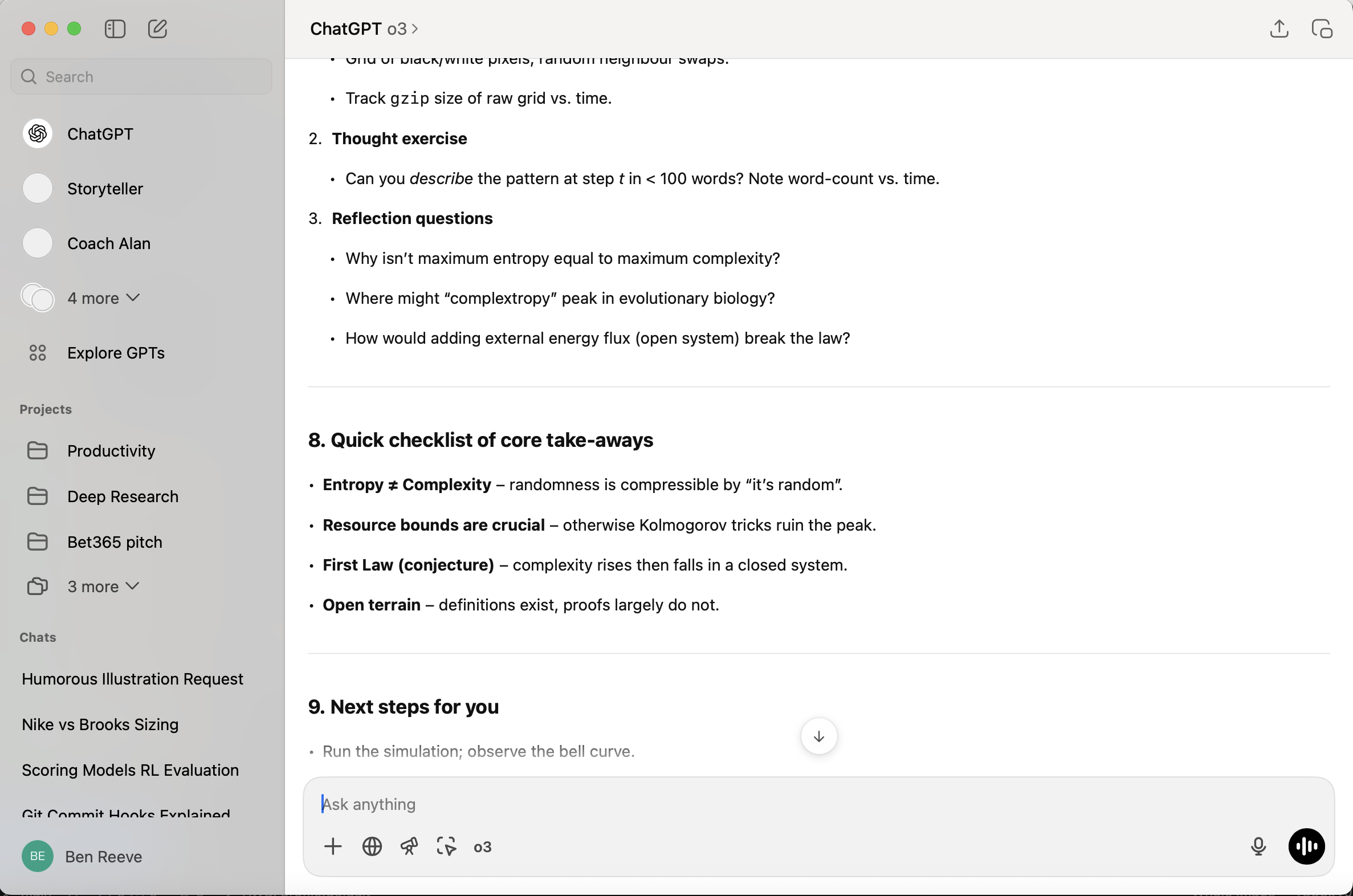
What you’re seeing in these screenshots is the academic equivalent of getting someone else to do your homework. I’ve asked ChatGPT to:
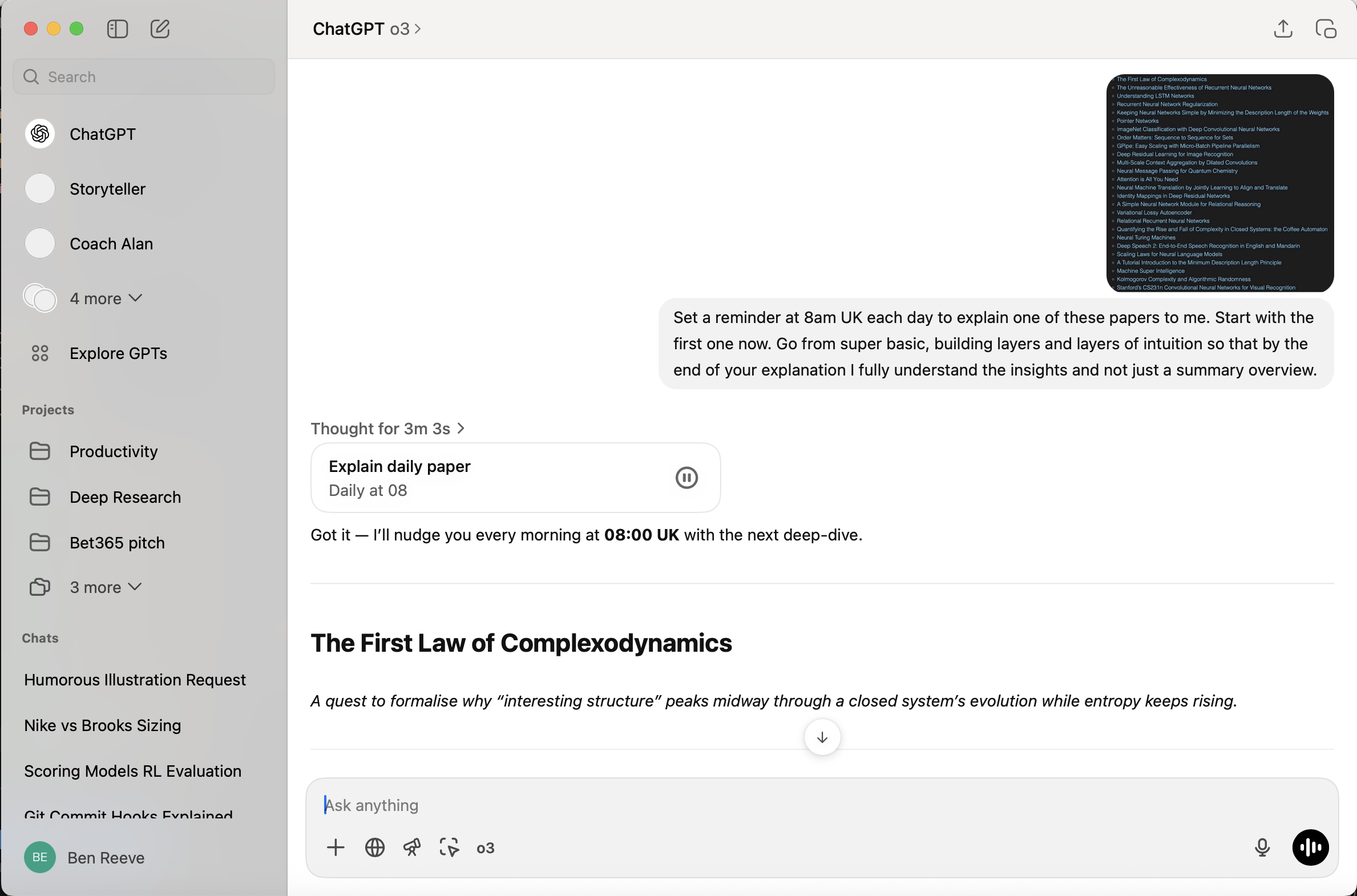
- Set a daily reminder at 8am
- Explain one paper per day, starting with remedial concepts a toddler could grasp
- Build up my understanding until I can fake expertise at dinner parties
This isn’t avoiding intellectual work—it’s outsourcing it to entities that don’t require sleep or caffeine.
Understanding entropy and complexity isn’t just academic navel-gazing—these concepts actually matter for AI. The tension between order and randomness underpins everything from how language models generate coherent text to why neural networks can generalize from training data. The “interesting structure” that emerges midway through a system’s evolution is precisely what we’re trying to capture when training trillion-parameter models, which I know because ChatGPT told me so.
From Complete Confusion to Partial Understanding
Within a single day’s explanation, ChatGPT constructed a learning framework that my uni professors would have appreciated: thought exercises, reflection questions, and bite-sized insights like “Entropy ≠ Complexity – randomness is compressible by ‘it’s random’.”
The Five-Minute MBA Economics
There’s a remarkable asymmetry here:
- Traditional learning: Reading academic papers (10+ hours I don’t have)
- AI-assisted learning: Daily micro-lessons (5 minutes while pretending to listen on conference calls)
The ROI is compelling.
The Knowledge Arbitrage Framework
The system is simple:
- Find intimidating papers that make you feel intellectually inadequate
- Make AI explain them to you like you’re five
- Gradually increase the complexity until you feel confident you understand the core concepts
- Repeat daily until you’ve convinced yourself you understand complexodynamics
I’ve created a personalized tutor that costs less than my morning coffee and doesn’t judge me when I ask it to repeat the same explanation four times.
The Asymmetric Knowledge Advantage
There’s something oddly liberating about this approach. I’m not pretending I’ll read 17 research papers—I’m letting a machine learning model transform them into a personalized curriculum that fits into my actual life.
Perhaps that’s the real insight from complexodynamics: optimal learning happens not through complete immersion or willful ignorance, but at that sweet spot where minimal effort meets maximum appearance of competence.
Just don’t tell Ilya I’m learning his recommended papers in five-minute increments between Slack notifications. Or do tell him, because I suspect he’s doing the same thing with some other field.