Reinforcement Learning Turns Large Language Models into Real Knowledge-Workers
Reinforcement Learning Turns Large Language Models into Real Knowledge-Workers
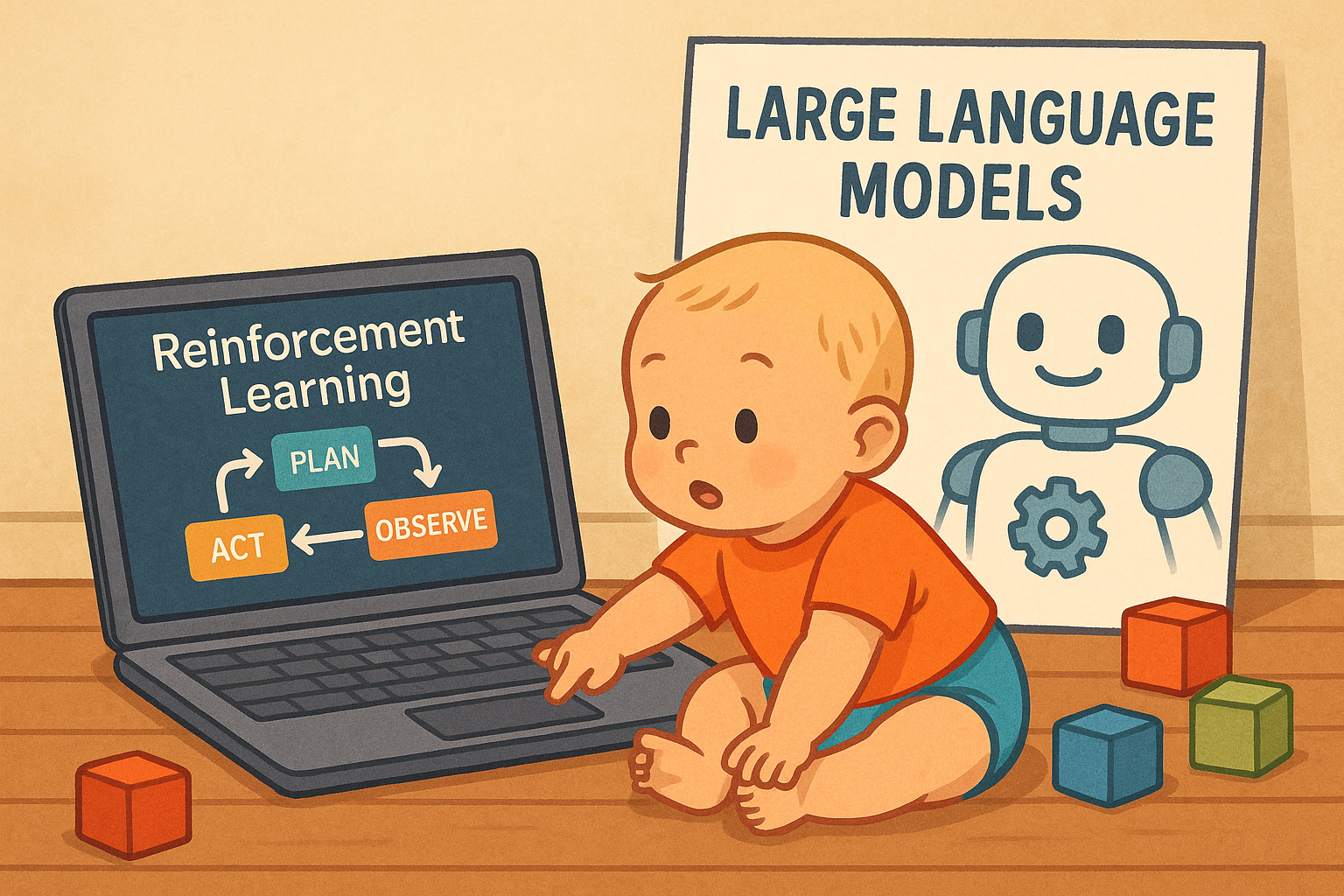
One of the great joys of observing artificial intelligence development is watching experts reluctantly anthropomorphize their creations. “The model isn’t thinking,” they insist while presenting research titled “Fast and Slow Thinking in Large Language Models.” It’s like watching parents who swore they’d never baby-talk their children dropping to all fours making airplane noises at mealtime. Let’s explore how reinforcement learning has transformed language models from glorified autocomplete into something that – while not conscious – certainly warrants some carefully hedged anthropomorphism.
1. Base LLMs: brilliant autocomplete, not autonomous thinkers
Pre-trained transformers like GPT-3 and LLaMA are essentially probability distributions with good PR. They complete text based on pattern recognition from trillions of tokens, which is impressive but fundamentally just an elaborate version of autocomplete. Without alignment, they’re simply chasing the most likely next token rather than pursuing your goals, which leads to those charming tendencies to hallucinate, drift off-topic, or suddenly generate something deeply inappropriate.
Researchers at OpenAI aptly compare this to “a Shoggoth with a smiley-face mask” – a vast, alien intelligence politely parroting human language until the mask occasionally slips. It’s why, somewhat embarrassingly for the base model enthusiasts, humans preferred the tiny 1.3B-parameter InstructGPT (tuned with reinforcement learning) to the much larger 175B-parameter GPT-3 for actual tasks. This preference wasn’t marginal – it was overwhelming. The base model might know more facts, but it’s like the brilliant colleague who can’t stay on topic during meetings.
You can use base LLMs for tasks that already resemble robots (templated emails, rote summarization), but treating them as agents is like handing your toddler the car keys because they made “vroom vroom” noises. They’re fascinating but still fundamentally undirected.
2. Reinforcement learning: the missing vector into knowledge work
RLHF, RLAIF and related techniques provide something base LLMs desperately lack: a way to care about outcomes. These methods attach explicit rewards to model behaviors (helpfulness, truthfulness, not causing diplomatic incidents), converting the frozen knowledge of a base LLM into goal-directed skill. The results are, frankly, dramatic:
| Task | Model | Humans beaten? |
|---|---|---|
| Long-form web Q&A | WebGPT | 56% of the time |
| Internet research & synthesis | OpenAI Deep Research | Super-human on the BrowseComp benchmark |
| Multi-turn conversation planning | Google Dialogue RL agent | Higher engagement than supervised assistant |
| Negotiation (Diplomacy) | Meta Cicero | Top 10% of human league |
While those of us who enjoy our cognitive superiority might quibble about the definition of “human-level” here, the pattern is unmistakable. Reinforcement learning supplies the feedback loop that knowledge work demands – plan, act, observe outcome, improve. Without RL, an LLM is like an encyclopedic intern who can recite facts but never learns from mistakes. With RL, it starts behaving like someone who actually wants to keep their job.
3. From Chessboards to the Open Web: RL in unbounded domains
Classic reinforcement learning triumphed in closed games with clear rules – like having a prodigy who can only play chess but can’t order lunch. Language shatters that boundary. Today’s RL-tuned LLM policies can browse websites, cite sources, negotiate terms, write code, call APIs, and revise plans mid-conversation. It’s like that chess prodigy suddenly developing a full repertoire of life skills.
Open-ended internet benchmarks such as BrowseComp explicitly score an agent’s ability to discover obscure facts across live webpages – tasks impossible to hard-code. DeepMind and OpenAI once built specialized systems for individual games; now they’re building general-purpose agents that navigate the open web like particularly single-minded humans. The crucial insight is that language itself provides enough structure to scaffold reinforcement learning, even without the convenient grid of a chessboard.
4. Why RL-tuned models feel like thinkers
When your toddler arranges blocks in a pattern, you might coo that they’re “being an architect.” You know they aren’t actually practicing architecture, but the metaphor is useful. Similarly, RL unlocks behaviors in LLMs that map neatly onto human cognitive frameworks:
-
Fast vs. slow thought – Meta’s Dualformer explicitly learns to jump between reflexive token generation and deliberate chain-of-thought reasoning, echoing Kahneman’s System 1/2 distinction. The model isn’t conscious, but it’s doing something algorithmically similar to what we do when switching from intuition to calculation.
-
Tool use – Toolformer self-learns when to call a calculator, web-search or translation API, just as a person reaches for the right instrument. It’s not making conscious decisions, but functionally speaking, it’s recognizing its limitations and augmenting them – which feels spookily agent-like when you interact with it.
-
Skill distillation – Self-play negotiation fine-tunes a policy that later runs in one shot, much like practicing until a maneuver becomes second nature. The model isn’t “practicing” in any psychological sense, but the mathematical process resembles how humans convert deliberate steps into fluent skills.
These emergent patterns make anthropomorphic language pragmatically accurate. When we say a model “decided to look something up,” we’re using a useful shorthand, not making metaphysical claims about silicon consciousness.
5. The agent avalanche – and the reliability wall
2023-24 witnessed an explosion of agent frameworks with names seemingly generated by the same models they contain (AutoGPT, BabyAGI, LangGraph, Bedrock Agents). Their promise: compose multiple LLM calls into workflows that plan → act → reflect.
Their reality: a three-agent chain with 90% accuracy per step cascades to 73% overall accuracy – and that’s assuming each step only happens once, which it rarely does. GitHub issue logs for AutoGPT read like the diary of someone trapped in a time loop with an increasingly confused companion. “It planned to write a blog post, then planned to plan to write a blog post, then planned to plan to plan…”
This compounding error stems from imitation learning’s fundamental limitation: the agent never saw its own mistakes during training. It’s like teaching someone to drive by showing them perfect demonstration videos but never letting them experience what happens when they drift out of their lane. RL provides the antidote – expose the agent to consequences, reward recovery, and train verifier/critic sub-agents that veto bad actions, much like you’d develop an internal voice saying “maybe don’t try to merge at this exact moment.”
6. Next frontier: multi-agent self-organisation
All major labs are repositioning around societies of agents, which seems both inevitable and slightly concerning – like watching toddlers organize themselves into surprisingly effective gangs:
- OpenAI formed a dedicated multi-agent research team led by the creators of Cicero (the Diplomacy-playing AI that mastered deception, which is not at all worrying).
- AWS Bedrock and Azure now offer orchestration APIs so enterprise users can spin up specialist agent teams, because apparently what corporate America needs is more meetings, just virtual ones.
These early protocols mirror human collaboration: message-passing and role-play rather than rigid function calls. RL-driven self-play will likely evolve these protocols beyond what hand-engineering can manage, creating emergent organizational structures (committees, reviewer-writer pairs, adversarial debaters) that outperform static pipelines.
We should expect both productive cultures and pathological dysfunctions – just as human firms exhibit innovation alongside bureaucracy and office politics. Current research aims to instill empathy-like objectives so agents reason about each other’s beliefs, reducing deadlocks and deception. It turns out that getting AI assistants to work together requires teaching them the same soft skills your HR department is always sending around emails about.
7. Strategic implications for business
Even if you lack GPUs or RL talent (and who doesn’t feel inadequate in at least one of those dimensions these days), the frontier advances will reach you via API:
-
Reliability leaps – RLHF/RLAIF models ship with lower hallucination rates and built-in tool use; plug-and-play agents will soon research, draft and verify documents end-to-end, making your “we thoroughly fact-checked this” disclaimer slightly less aspirational.
-
Process re-design – Map workflows where human QA currently patches LLM errors; those gates will disappear as RL-trained verifiers mature. The person whose job is “check if the AI hallucinates” might want to update their LinkedIn.
-
Competitive pressure – Rivals that adopt RL-aligned agents earlier will slash cycle times on research, coding and analysis. The “move fast and break things” ethos becomes “move fast and let the AI fix things.”
-
Org insights – Observing how agent teams self-organize may surface novel management patterns you can port back to human teams. Perhaps the greatest irony: we might learn how to structure human organizations more effectively by watching how our simulated employees organize themselves.
The actionable takeaway: track RL progress even if you never train a policy yourself. Pilot agent frameworks now, budget for reliability upgrades in six-month cycles, and cultivate internal expertise to recognize when a new RL-tuned capability crosses the threshold from “impressive demo” to “competitive advantage.”
8. Key takeaways
-
Base LLMs ≈ brilliant autocomplete. Alignment is optional for demos, mandatory for production. Unaligned models are like savants who can recite encyclopedias but might also unexpectedly recite inappropriate limericks during client meetings.
-
RL is the catalytic layer that makes LLMs goal-oriented knowledge workers. If a base LLM is raw talent, RL is the combination of ambition, training, and feedback that turns potential into performance.
-
Open-ended RL is already super-human in tasks like web research and negotiation. The machines aren’t just playing games anymore; they’re navigating the same information environments we are.
-
Anthropomorphic metaphors are now productive design tools, provided we remember the underlying math. The model isn’t “thinking,” but describing it that way helps us build better systems, much like how physicists talk about electrons “wanting” to find the lowest energy state.
-
Agent reliability is the bottleneck; RL-based self-play, critique and empathy objectives are the path forward. Current autonomous agents are like eager interns who confidently execute fundamentally flawed plans; we need them to develop the voice in their head that says “wait, this doesn’t sound right.”
-
Multi-agent ecosystems will evolve rapidly; expect emergent “organizational theory” for AIs – and learn from it. We might soon discover that our human organizational structures aren’t optimal, which will be both useful and slightly humbling.
-
Businesses should prepare today: monitor RL-aligned API releases, redesign processes around trustworthy agents, and cultivate an RL-literate workforce. The company that successfully deploys these technologies first gains advantages similar to early internet adoption – minus the questionable fashion choices.
The era of chatbots as parlor tricks is closing. The era of RL-honed, tool-wielding, self-organizing AI colleagues has begun. Whether they’ll be more pleasant to work with than your current teammates remains an open empirical question.