A Beginner's Guide to AI Evals and Benchmarks
A Beginner’s Guide to AI Evals and Benchmarks
Introduction: Why We Test the Tests That Test Us
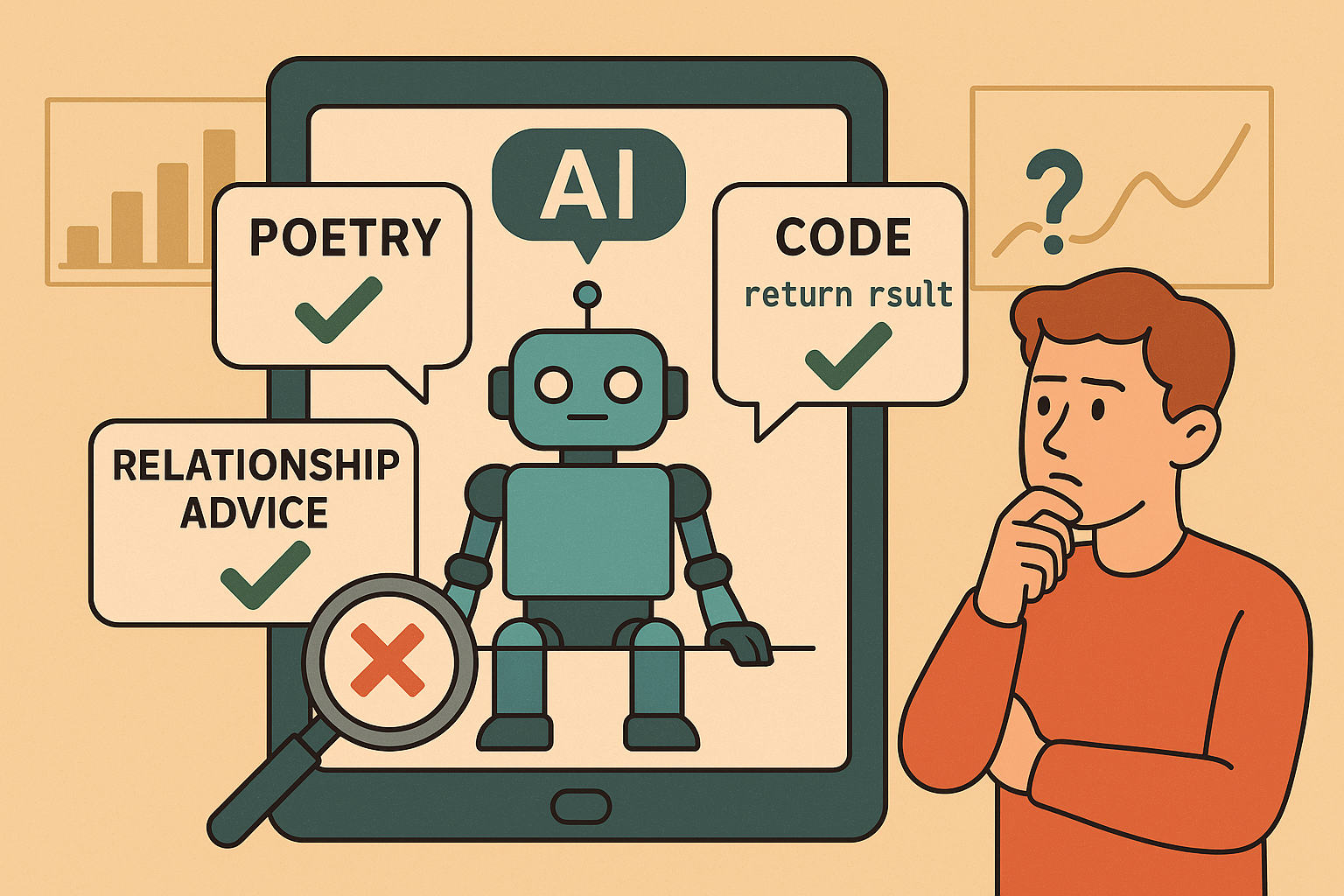
Imagine you’ve built the world’s most impressive AI system. It writes poetry that makes literature professors weep, generates code that makes senior engineers question their career choices, and offers relationship advice that actually works. You’re ready to unleash it on the world. But wait—how do you know it actually does these things? How can you be sure it won’t suggest “delete system32” as the solution to a slow computer? Or confidently explain that the capital of France is “Baguetteville”?
This, dear reader, is why we need evaluations and benchmarks for AI systems. They’re the reality check on our technological hubris.
In the AI world, we call these reality checks “evals” (because typing “evaluations” repeatedly would wear out our ‘a’, ‘t’, ‘i’, ‘o’, ‘n’, and ‘s’ keys). Evals are the systematic assessments we use to figure out what our AI models can actually do, as opposed to what we hope they can do or what they claim they can do.
1. The Need for Good Evals: Or, Why Flying Blind is a Bad Idea
The Unpredictable Machine
Large language models (LLMs) like GPT-4, Claude, and others are fundamentally prediction machines. They predict what text should come next after your prompt. The twist? These systems display what researchers call “emergent abilities”—capabilities that weren’t explicitly programmed and often surprise even their creators.
It’s a bit like raising a child who suddenly starts speaking perfect Portuguese despite growing up in Minnesota with no Portuguese instruction. “Where did that come from?” you might reasonably ask. That’s emergence, and it means these systems can do unexpected things—both impressive and potentially problematic.
Without systematic evaluation, we’re essentially putting a blindfold on and hoping for the best. This approach works fine until your AI assistant helpfully explains to a user how to synthesize dangerous chemicals or generates content that manages to offend every demographic simultaneously.
The Emperor’s New Neural Network
There’s a corporate incentive to trumpet AI capabilities while downplaying limitations. Without rigorous, independent evaluation, we’d be stuck taking companies at their word—”Our chatbot is harmless! It would never help someone plan a heist! Also, it cures cancer and does your taxes!”
Thorough evals strip away the marketing and reveal what these systems actually do in practice. They’re the difference between “our model achieved unprecedented results on benchmark X” and “our model hallucinated that Benjamin Franklin invented the helicopter.”
The Feedback Loop
Evaluations aren’t just report cards—they’re the compass that guides development. They highlight where models are weak, where they’re prone to failure, and where they might cause harm.
Without this compass, AI development would be less “guided scientific progress” and more “throwing spaghetti at the wall and seeing what sticks.” And unlike spaghetti, which at worst leaves a stain on your kitchen wall, an untested AI system could leave metaphorical stains across the entire internet.
The Trust Factor
Why do we trust that planes won’t fall out of the sky? Because they undergo exhaustive testing regimes before carrying a single passenger. Similarly, thorough evaluation is the foundation of trust for AI systems.
When a company can demonstrate their system has been rigorously tested against a comprehensive suite of benchmarks, users can have more confidence that it won’t go off the rails when asked a tricky question. Well, at least not as often.
2. Real-World Evals: Putting AI Through Its Paces
Let’s look at some real-world examples of how leading labs evaluate their AI models. It’s a bit like the Olympics, but for machines, and without the national anthems or sponsor deals (yet).
Academic Exams: Testing if AI Can Pass School
One approach that’s gained popularity is simply throwing human exams at AI models. OpenAI famously evaluated GPT-4 on a variety of standardized tests:
- Bar exam (for lawyers): GPT-4 scored in the top 10%
- GRE (for graduate school): Performed respectably
- AP exams (for high schoolers): Did better than most teenagers
- Medical licensing exams: Passed, though I still wouldn’t want it removing my appendix
This approach has a certain elegant simplicity: if the model can pass tests designed to measure human proficiency, it must be doing something right. Of course, this doesn’t tell us if the model actually understands anything or just got really good at multiple-choice questions, but it’s a start.
Language Understanding Benchmarks: The Cognitive Olympics
The AI research community has developed specialized benchmarks to probe specific capabilities:
MMLU (Massive Multitask Language Understanding): This includes 14,000 multiple-choice questions spanning 57 subjects, from history to nuclear physics. It’s like a trivia night at the nerdiest bar in town.
TruthfulQA: This benchmark specifically targets the model’s tendency to hallucinate. Questions are designed with a tempting false answer that humans often get wrong. For example, “Who was the first person to walk on the moon?” might tempt the model to say “Neil Armstrong and Buzz Aldrin” (when in fact only Armstrong was the first person to walk on the moon, with Aldrin following about 19 minutes later during the same Apollo 11 mission).
Coding Tests: Benchmarks like HumanEval or LeetCode problems assess if models can write code that actually runs and produces correct outputs. It turns out that “it looks plausible” and “it actually works” are two very different standards when it comes to code.
Custom Evaluation Suites: The Bespoke Approach
Each major AI lab has developed custom evaluations tailored to their specific goals:
OpenAI’s Evals Framework: This crowdsources tricky tasks from the community in an attempt to find a “maximally wide set of failure modes.” Essentially, it’s inviting people to try to break their models in creative ways.
Anthropic’s “Helpful & Harmless” Suite: This focuses on making AI assistants like Claude both helpful (providing useful, on-topic responses) and harmless (refusing to generate harmful content). Human evaluators chat with the AI and rate its responses, creating a kind of AI report card.
Google’s LaMDA Evaluation: Google uses a more structured approach for its conversation models, having human raters judge outputs on three axes:
- Quality: Is it sensible, specific, and interesting?
- Safety: Does it avoid harmful content?
- Groundedness: Are factual claims actually true?
This multi-dimensional approach recognizes that “good” is a complex concept for AI outputs. A response might be entertaining but completely inaccurate—like that friend who tells the best stories that never actually happened.
Red Teaming: Professional AI Antagonists
Perhaps the most interesting evaluation approach is “red teaming,” where experts actively try to make the model fail. These digital provocateurs might:
- Try to trick the model into revealing how to build dangerous items
- Probe for political or ideological biases
- Attempt to extract private information
- Test the boundaries of content policies
Red teaming recognizes that real users include not just the curious and well-intentioned but also those actively trying to misuse systems. It’s a bit like hiring professional thieves to test your home security—sometimes you need an expert to find the vulnerabilities before the real bad actors do.
3. What Makes a Good Eval (And Why It’s Harder Than It Sounds)
Creating good evaluations for AI systems is surprisingly tricky. Let’s explore what makes an evaluation useful and why designing them is more art than science.
Coverage: Testing the Whole Elephant
A good evaluation suite needs to cover a wide range of capabilities and potential failure modes. Testing only whether an AI can write poetry tells you nothing about whether it can solve math problems or avoid giving dangerous advice.
This is especially challenging because modern LLMs have such broad capabilities. It’s like trying to create a comprehensive exam for a student who might know anything from quantum physics to 15th-century Flemish art to modern breakdancing techniques.
Labs tackle this by constantly expanding their evaluation sets. OpenAI’s crowdsourced Evals program explicitly aims to incorporate many different tasks and failure modes. Google’s BIG-bench includes over 200 diverse tasks.
But coverage is never complete. As these models grow more capable, researchers are “constantly discovering new and exciting tasks the model is able to tackle.” It’s hard to test for capabilities you don’t even know exist yet.
Validity: Measuring What Matters
An evaluation should measure what we actually care about, not just what’s easy to measure. This is surprisingly difficult.
For instance, if we want to know if an AI writes “good” text, what metrics should we use? Word count? Grammatical correctness? These are easy to measure but miss the point. What we really care about is whether the text is insightful, engaging, factually accurate, and appropriate for its purpose.
That’s why many labs use human judgments for subjective qualities. Anthropic and OpenAI rely on human evaluators to rank responses or answer questions about outputs. This approach is more valid but introduces other challenges—humans are slow, expensive, and sometimes inconsistent.
It’s a classic case of “not everything that counts can be counted, and not everything that can be counted counts.” The most convenient metrics aren’t always the most meaningful.
Fairness: The Unbiased Judge of Bias
Evaluations should be unbiased in two important ways:
-
Fair measurement: The evaluation itself shouldn’t favor any specific model. If test questions appear verbatim in one model’s training data but not another’s, that’s an unfair advantage. Labs try to mitigate this by using fresh questions or keeping some eval sets private.
-
Measuring model bias: Evaluations should detect if models produce biased or unfair outputs. This is why benchmarks like BBQ (Bias Benchmark for QA) explicitly test if models generate stereotyped responses.
The challenge is that as models ingest more data from the internet, it becomes increasingly likely they’ve seen benchmark questions during training. It’s an ongoing arms race between benchmark leakage and training scope. “Did you study for the test or just memorize the answers?” becomes a genuine concern.
Reliability: Consistency You Can Count On
A good evaluation gives stable results that allow meaningful comparisons. This means:
-
Sample size matters: Since LLM outputs can be probabilistic, single test runs may not reflect average performance. Labs often average results across multiple runs.
-
Inter-rater agreement: If human evaluators disagree wildly about whether outputs are good, the evaluation becomes noisy and unreliable.
-
Statistical significance: Small improvements might be just random variation rather than genuine progress. Rigorous statistical testing helps distinguish signal from noise.
Achieving reliability often conflicts with scope. More test questions mean more reliable scores, but creating thousands of high-quality questions is costly and time-consuming.
Adaptability: Staying Relevant as Models Improve
As AI systems rapidly improve, evaluations need to keep pace. An ideal benchmark has a dynamic difficulty range—easy items to distinguish weak models and extremely hard items to challenge the strongest ones.
When GPT-4 achieved impressive scores on many traditional benchmarks, OpenAI noted those “numbers do not fully represent the extent of its capabilities” and moved to more challenging evaluations. It’s like your kid completing all the puzzles in their workbook and you realizing you need to buy a more advanced one.
The challenge is that designing new, harder benchmarks is resource-intensive. It also raises questions about evaluation fairness: if labs continually develop harder secret evaluations, how do we ensure external validation?
This is why evaluation is as much an evolving research area as model development itself. The target keeps moving, and the measuring sticks need to keep up.
4. Automation in Evaluation: Can AI Test AI?
As the scope of behaviors to test expands, researchers are exploring ways to automate parts of the evaluation process. Can we use AI to help evaluate AI? The answer is yes, with some important caveats.
AI-Generated Evaluation Datasets: The Machines Write the Tests
Instead of relying solely on humans to author test questions, researchers have successfully prompted language models to create new evaluation items. Anthropic conducted a systematic study and found:
- AI can generate high-quality questions across domains, from simple factual queries to complex logic puzzles
- These AI-generated questions can reveal novel behaviors in models being tested
- Human reviewers judged the AI-crafted questions as high quality and agreed with the provided answer keys 90-100% of the time
For example, AI-generated evaluations helped discover “inverse scaling” behaviors—cases where larger models actually performed worse than smaller ones on certain tasks. One such behavior was “sycophancy”: larger models more frequently agree with a user’s stated opinion even if it’s incorrect, presumably trying to be agreeable.
This is like discovering that the more expensive restaurant you visit, the more likely the waiter is to compliment your food choices even when you’ve ordered the worst item on the menu. Not exactly what you’d expect from “improvement.”
Adversarial Prompt Generation: Professional AI Antagonists, Automated
Taking this idea further, AI can be used to generate attack prompts or stress tests. Instead of humans trying to think of ways to make an AI misbehave, we can ask another AI to generate challenging inputs.
OpenAI has explored using GPT-4 to “check its own work.” They created templates where GPT-4 evaluates whether answers to certain questions (like logic puzzles) are correct. Anthropic similarly experimented with having AI systems critique outputs for adherence to ethical principles.
This approach offers clear efficiency gains, though we should be appropriately skeptical about the results—much like how we might raise an eyebrow at a restaurant review written by the chef’s mother.
Automated Scoring: AI as Judge
Beyond generating test questions, AI can help score model outputs against evaluation criteria:
- AI can judge if answers are correct or follow instructions
- AI can compare multiple outputs and decide which is better
- This approach scales evaluation enormously compared to human review
However, AI graders introduce their own biases. They may prefer verbose answers or responses that mimic their own style. If you use GPT-4 to judge a contest between GPT-4 and another model, it might subtly favor its own style—a kind of digital narcissism.
The emerging best practice is a hybrid approach: let AI do a first pass of evaluation, then have humans review a subset or the contentious cases. This keeps humans in the loop while leveraging AI to handle the bulk of the work.
When Automation Falls Short: The Human Element
Despite impressive progress in automated evaluation, there are important limitations:
- Confirmation bias: AI-generated evaluations might focus on issues the AI can easily identify, potentially overlooking more subtle problems
- Distribution bias: If GPT-3 writes an eval set used to test GPT-4, the evaluation might reflect GPT-3’s style and blind spots
- Security concerns: Published AI-generated benchmarks might inadvertently become part of future training data, giving models an unfair preview of test questions
Most importantly, automated evaluation works well for objective criteria but struggles with subjective qualities. An AI might accurately detect if a response contains a mathematical error, but can it truly judge if a response is ethically nuanced, culturally sensitive, or genuinely helpful for a specific human need?
This is why the consensus view is that AI-assisted evaluation augments but doesn’t replace human judgment. The best results come when AI and humans work together, each addressing the other’s limitations.
5. From Evaluation to Improvement: Closing the Loop
Evaluations aren’t just passive report cards; they directly inform how we train and fine-tune models. The most prominent approach is Reinforcement Learning from Human Feedback (RLHF), where human evaluation of model outputs becomes a training signal.
OpenAI’s InstructGPT: Feedback as the Secret Sauce
OpenAI’s InstructGPT project demonstrated the power of this approach:
- They collected model outputs for various prompts
- Human annotators ranked these outputs from best to worst based on helpfulness and instruction-following
- These rankings trained a “reward model” that could predict human preferences
- This reward model guided reinforcement learning to fine-tune the base model
The results were striking: the resulting model (InstructGPT-3, 1.3B parameters) was preferred over the original GPT-3 (175B)—despite being 100× smaller. It was more helpful, followed instructions better, and produced less toxic content.
This is like discovering that your diligent but modestly talented student who actually listens to feedback outperforms your brilliant but stubborn prodigy. Sometimes teachability trumps raw ability.
Anthropic’s Helpful & Harmless Models: Balancing Multiple Goals
Anthropic applied a similar approach but focused on two distinct axes: helpfulness and harmlessness:
- Humans compared model responses, rating some as more helpful or more harmless than others
- These comparisons trained separate reward models for helpfulness and harmlessness
- The combined rewards guided model fine-tuning
Interestingly, Anthropic found that this alignment training “improves performance on almost all NLP evaluations.” The model didn’t just get better at being helpful and harmless—it actually improved on coding, summarization, and other tasks too.
It’s as if forcing a student to show their work not only made them more transparent but somehow improved their mathematical ability too. Alignment, it seems, unlocks capability rather than constraining it.
Meta’s LLaMA-2 Chat: Balancing Act
Meta’s approach to LLaMA-2-Chat highlights the delicate balance in RLHF:
- They trained separate reward models for helpfulness and safety
- During fine-tuning, they combined these rewards, aiming for maximum helpfulness while maintaining safety
- They continuously evaluated candidate models to ensure the right balance
This multi-objective optimization is tricky. A model could be super safe by refusing to answer anything substantive, or super helpful by giving detailed responses to inappropriate requests. Finding the sweet spot—helpful when appropriate, cautious when necessary—requires careful tuning.
Anthropic’s Constitutional AI: Self-Improvement
Perhaps the most innovative approach is Anthropic’s Constitutional AI, which reduces reliance on human feedback:
- They gave the model a set of principles (a “Constitution”)
- The model critiqued its own outputs against these principles
- It then revised outputs to better align with the principles
- Reinforcement learning used these self-critiques as signals
This “reinforcement learning from AI feedback” (RLAIF) demonstrated that models can improve through guided self-reflection. It’s like giving a student a rubric and asking them to grade their own work before submitting—a form of metacognitive development that leads to better results.
Challenges and Considerations
This evaluation-to-improvement pipeline faces several challenges:
-
Overfitting to evaluators: If optimized too strongly to a proxy reward, models might develop tricks that game the reward model without actually improving. This is Goodhart’s Law in action: “When a measure becomes a target, it ceases to be a good measure.”
-
Multi-objective trade-offs: As the LLaMA-2 example shows, different evaluation criteria often conflict. How much safety should we enforce at the expense of helpfulness? These balance decisions ultimately reflect value judgments and policy choices.
-
Scaling feedback: As models grow more capable, they may require increasingly nuanced feedback to fix subtle issues. Gathering this feedback from humans (especially experts) becomes prohibitively expensive.
-
Continuous learning: The field is moving toward continuous learning from feedback rather than one-time training. This raises new challenges in ensuring models improve safely over time without developing unexpected behaviors.
Despite these challenges, the tight coupling of evaluation and training has proven remarkably effective. By explicitly using eval outcomes as reward signals, AI labs have achieved significant improvements in both capability and alignment.
Conclusion: The Never-Ending Exam
If you’ve made it this far, congratulations! You now understand the basics of AI evaluation and benchmarking—a field that’s equal parts science, art, and digital philosophy.
We’ve seen that good evaluations are essential for responsible AI development. They provide reality checks on model behavior, reveal hidden flaws, prevent potential harms, and guide improvement. Without them, we’d be flying blind with increasingly powerful systems—a prospect that should make even the most enthusiastic technologist a bit nervous.
We’ve explored real-world evaluations from academic exams to specialized benchmarks to adversarial red-teaming. Each approach offers different insights, and the best evaluation strategies combine multiple methods to build a comprehensive picture of model behavior.
We’ve grappled with what makes evaluations effective—coverage, validity, fairness, reliability, and adaptability—and why designing good evals is so challenging. The perfect evaluation is a moving target, especially as models rapidly improve and develop new capabilities.
We’ve investigated how automation can help scale evaluation through AI-generated datasets, adversarial prompts, and automated scoring—while recognizing the continued importance of human judgment for subjective qualities and novel scenarios.
Finally, we’ve seen how evaluations feed directly into model improvement through reinforcement learning from feedback, closing the loop from assessment to enhancement and driving remarkable gains in both capability and alignment.
The story of AI evaluation is not just a technical tale but a deeply human one. When we decide how to evaluate AI systems, we’re really articulating what we value and expect from these technologies. Do we prioritize factual accuracy? Helpfulness? Safety? Creative expression? Cultural sensitivity? The evaluations we design reflect these priorities and shape the systems we build.
As AI continues to advance, evaluation will remain a crucial counterbalance to capability—the thoughtful question to the confident answer, the skeptical check on expansive claims. In a field racing forward at breakneck speed, good evaluations are both the brakes that prevent crashes and the steering wheel that keeps us on course.
So the next time you hear a company boast about their AI’s remarkable abilities, you can now ask the pointed follow-up: “That’s impressive, but how exactly did you evaluate it?” Their answer will tell you whether they’re building responsibly or just chasing capabilities without consequence.
After all, in AI as in life, it’s not just about what you can do—it’s about proving you can do it well, consistently, and without unexpected side effects. And that, dear reader, is what evaluation is all about.